How to Play Gacha Games Free-to-Play: Earning Pulls Without Spending
Where free pull currency comes from in Genshin, Star Rail, ZZZ and Wuthering Waves, how to plan pulls, why skipping banners helps, and how F2P players finish the story.

Every major gacha game on PC and console is free to download, and every one of them can be played from start to finish without spending money. That is not a marketing line: the main story, the open world, most events and the recurring endgame modes are all accessible to a player who never opens the shop. What changes without spending is how many characters you collect and how quickly, not whether you can enjoy the game.
This guide covers where free pull currency comes from, how to plan pulls so they go further, why skipping banners is a skill rather than a sacrifice, and what a free-to-play (F2P) player can realistically expect. It applies broadly to Genshin Impact, Honkai: Star Rail, Zenless Zone Zero and Wuthering Waves, with game-specific names where useful.
What “free-to-play” really means
Strictly, an F2P player is someone who has spent nothing at all. The term gets stretched in community discussions to include people who buy only a monthly pass, but in this guide F2P means zero spending.
Being F2P is a legitimate way to play, not a lesser one. Developers design these games so that the content all players can access is clearable with the characters the game gives away and the ones you can earn. Story content in particular is tuned so that a reasonably levelled team of free and early characters can finish it. The things F2P players most often have to accept are slower collection, fewer duplicate copies and occasionally needing more attempts at the hardest endgame challenges.
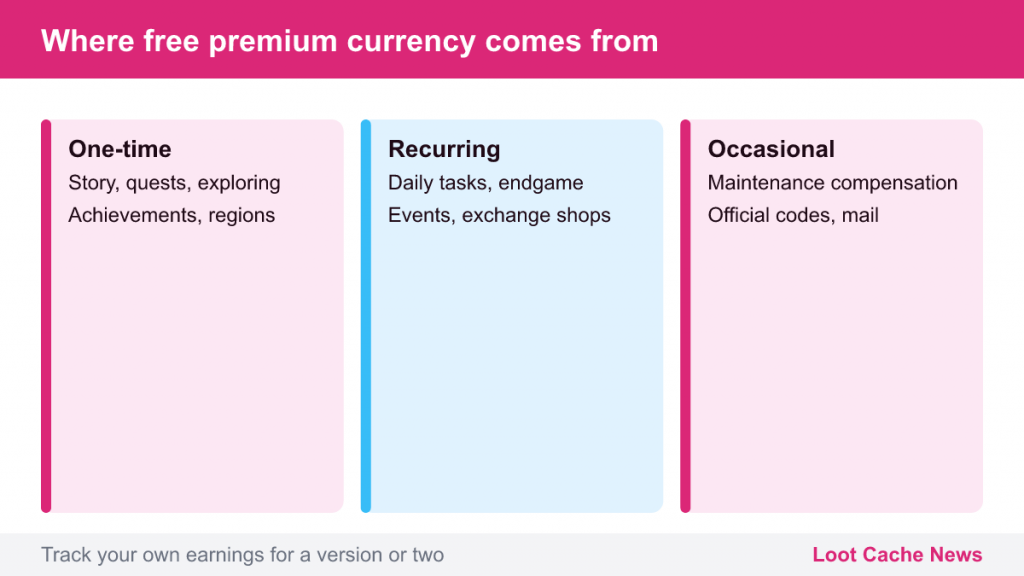
Where free premium currency comes from
Every game pays out premium currency (Primogems, Stellar Jade, Polychromes or Astrite) through many small sources. Our gacha currencies explainer covers how that currency converts to pulls; here are the main ways to earn it.
One-time sources
- Story and quests. Main story chapters, character stories and side quests award currency on completion.
- Exploration. Open-world games, especially Genshin Impact and Wuthering Waves, hide chests, puzzles and collectibles across each region, and completing exploration progress pays out.
- Achievements. Most games have long achievement lists that reward currency for milestones and unusual feats.
- Level milestones. Account and world level progress often comes with rewards.
- New-region and new-area launches. Each new map area brings a fresh batch of chests and quests.
One-time sources are generous early on, which is why new accounts often have more pulls available in their first weeks than at any other time. They are finite, though, so long-term F2P planning depends on the recurring sources below.
Recurring sources
- Daily tasks. Commissions in Genshin, Daily Training in Star Rail, daily activities in Zenless Zone Zero and the Activity system in Wuthering Waves each reward a small amount every day.
- Endgame resets. Recurring challenge modes such as Spiral Abyss and Imaginarium Theater in Genshin, Memory of Chaos, Pure Fiction and Apocalyptic Shadow in Star Rail, Shiyu Defense and Deadly Assault in ZZZ, and Tower of Adversity in Wuthering Waves reset on a regular schedule and pay out currency based on your performance.
- Events. Each version brings limited-time events, many of which reward premium currency for simple participation.
- Login events. Special login campaigns, often around launches and anniversaries, reward currency or tickets for simply logging in on set days.
- Battle pass free tracks. Most games have a seasonal pass with a free track that includes some rewards.
- Exchange shops. Duplicate results give exchange currency (such as Masterless Starglitter or Undying Starlight) that can be traded for tickets on a monthly cycle.
Occasional extras
- Maintenance compensation. After each version update, players typically receive premium currency to make up for server downtime, and extra compensation for bugs.
- Redemption codes. Official preview livestreams usually reveal codes for small amounts of currency. Only use codes from official channels; anything that asks for login details to give “free currency” is a scam.
- Mail rewards. Developers sometimes send gifts for anniversaries, milestones or holidays.
We deliberately avoid quoting exact monthly totals. They vary by version, depend on how much content a player completes, and are often overstated in hype-driven videos. A better habit is to track your own earnings for a version or two, which gives you a realistic baseline for planning.
Planning pulls: the core F2P skill
Because free currency arrives slowly, the most important F2P skill is deciding where it goes. A few principles make a huge difference.
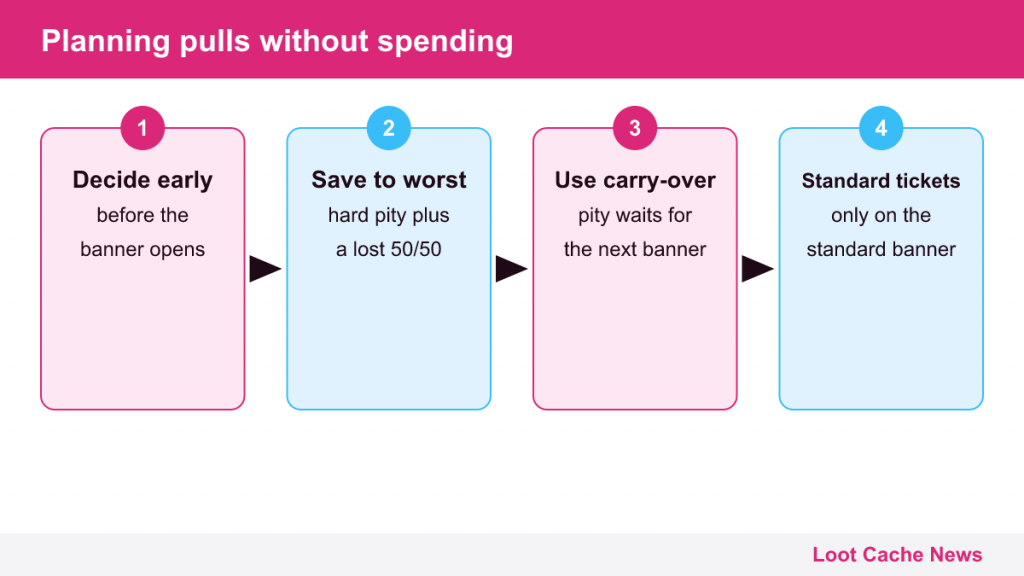
Decide before the banner starts
New characters are revealed in livestreams and trailers before their banners open. That gives you time to decide calmly, rather than in the moment the banner goes live. A good question to ask is whether the character fills a role your team actually lacks, or whether you just like them, which is a perfectly valid reason, as long as the choice is deliberate.
Save to the worst case, not the best case
Plan around hard pity and the possibility of losing the 50/50, not around getting lucky. If you only have enough pulls for a lucky outcome, waiting until you have enough for the worst case avoids ending a banner with a half-filled pity counter and no character. The numbers depend on the game, but the logic is the same everywhere.
Check the counter carry-over
In the major games, pity and guarantee status carry over between limited banners of the same type. That means pulls are never fully wasted, but it also means a partly used pity can tempt you into “just finishing” it on a banner you don’t really want. Carry-over is a reason you can afford to wait.
Use standard tickets on the standard banner
Standard tickets come free from many sources and can only be used on the permanent banner. Using them there is effectively a bonus. Many F2P players get several useful characters from these tickets over time.
Why skipping banners is a skill
Gacha games release new characters constantly, usually several per version. No player, F2P or otherwise, needs all of them. Skipping banners is the main way F2P players build up enough currency to guarantee the characters they really want.
A few things make skipping easier:
- Reruns happen. Many limited characters return on later banners. Timing is never guaranteed, but the fear that a character will never come back is often exaggerated.
- New characters are not always stronger for your team. A character can be powerful in general but add little to the team you already have.
- Story does not require any specific character. Every story chapter is designed to be cleared with free characters and those reasonably available.
- Trials let you test first. Most games offer trial runs of new characters during their banners, so you can see whether you enjoy them before spending anything.
Treat every banner as optional by default. Saying no most of the time is what makes yes meaningful when it matters.
Using free characters and earned characters
Each game gives away characters through its story, events and early progression. These are often well-designed, versatile units that remain useful for a long time. Genshin’s Traveler can switch elements, Star Rail’s Trailblazer changes Paths through the story, and Wuthering Waves’ Rover gains new attributes. Some events also offer a free choice of characters.
Investing in these characters is one of the most efficient things an F2P player can do. Raising their levels, talents and equipment costs only stamina and time, not pulls. Our stamina systems explainer covers how to spend those daily resources sensibly.
What F2P players can and cannot expect
| Expect | Don’t expect |
|---|---|
| To finish the full main story and most events | To own every new character |
| To build several solid teams over time | To collect duplicate upgrades for most characters |
| To clear most endgame content with planning | To get top scores in every endgame mode every cycle |
| To pull the characters you most want, if you save | To get signature weapons for everyone |
Expectations matter. Content creators and highlight videos often feature accounts with heavy spending, which can make an ordinary F2P account look weak by comparison. Comparing your progress with that kind of account is like comparing a household budget with a lottery winner’s. The relevant question is whether you are enjoying the game, not whether you match someone else’s collection.
Common F2P mistakes
- Pulling on every banner a little. Spreading pulls thin leaves you with partial pity everywhere and few guaranteed characters.
- Spending premium currency on stamina refills. It is almost always better saved for pulls.
- Converting currency into the wrong ticket. Standard tickets cannot be used on limited banners.
- Chasing the meta. The strongest characters change often, and the endgame is rarely the point of the game for most players.
- Forgetting exchange shops. Monthly ticket exchanges are free pulls many players never claim.
- Feeling guilty about not spending. F2P is a design option the developers built in deliberately, not freeloading.
Staying F2P under pressure
The games are built to encourage spending, with time-limited banners, first-purchase bonuses and pop-up offers. Staying F2P is easier if you decide in advance that your spending limit is zero, treat that as a rule rather than a daily decision, and use platform spending controls to make it stick. If you ever find yourself thinking about spending to “fix” a lost 50/50 or to reach pity before a banner ends, that is usually the moment to step back. Our gacha glossary explains the jargon, such as FOMO, that these moments tend to come wrapped in.