Gacha Currencies Explained: Primogems, Stellar Jade, Polychromes and Astrite
How premium currencies, paid crystals, pull tickets and exchange shops fit together in Genshin, Star Rail, ZZZ and Wuthering Waves, and why the layers matter.
Open the shop in almost any modern gacha game and you will meet three or four currencies before you see a character: a premium currency you earn by playing, a second one you can only buy, a pull ticket that the first two turn into, and “leftover” currencies from duplicate results. Every game uses different names for essentially the same structure.
This explainer maps that structure for the four big HoYoverse and Kuro Games titles on PC and console: Genshin Impact, Honkai: Star Rail, Zenless Zone Zero and Wuthering Waves. The goal is not to tell you how to buy anything. It is to make the conversion chain visible, so you can always translate “a ten-pull” back into what it would cost in time or money, and decide calmly whether you want to spend either. If you are new to banners themselves, our guide to limited vs standard banners covers what the tickets are actually spent on.
The four layers almost every gacha uses
Strip away the branding and the four games share the same skeleton:
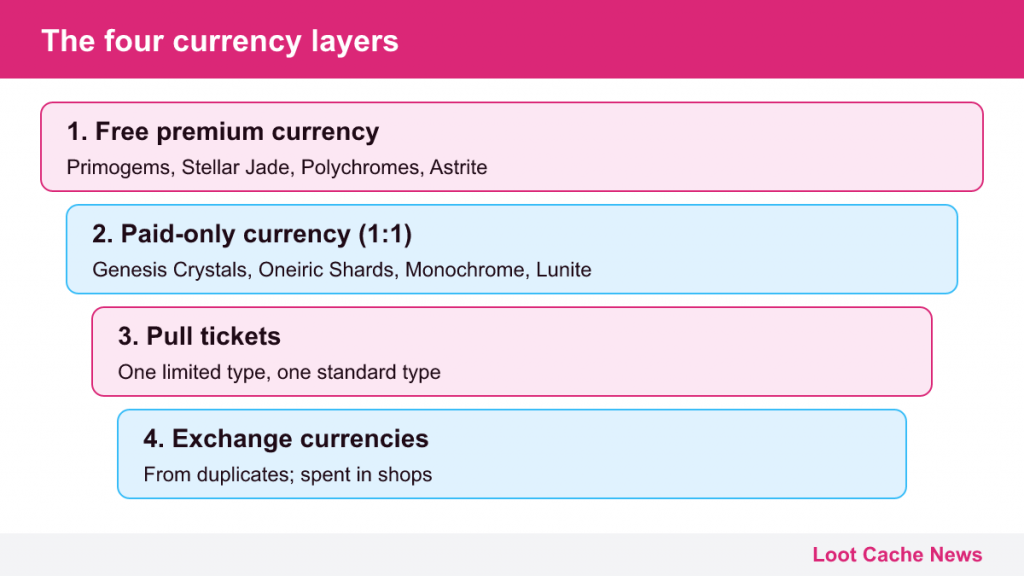
- Free premium currency. The currency you earn from quests, exploration, events, endgame modes and daily tasks. Primogems, Stellar Jade, Polychromes and Astrite all sit here. It is “premium” because it buys pulls, but you can earn a meaningful amount without spending money.
- Paid-only currency. A separate currency that is sold for real money and can be converted into the free premium currency at a fixed ratio (1:1 in all four games). Genesis Crystals, Oneiric Shards, Monochrome and Lunite fill this role.
- Pull tickets. The actual item consumed on a banner. Each game has one ticket type for limited banners and one for the standard banner, and in three of the four games the same limited ticket is used on weapon or equipment banners as well (Wuthering Waves adds a third type, covered below).
- Exchange or “shop” currencies. Currencies you receive automatically when a pull gives you a duplicate or a low-rarity item. They can be traded back into tickets and other items in a dedicated shop, often with monthly limits.
On top of these four layers sit everyday currencies such as Mora, Credits, Dennies and Shell Credits, which pay for levelling and upgrades. Those are not part of the pull economy and are not covered here.
The magic number: 160 per pull
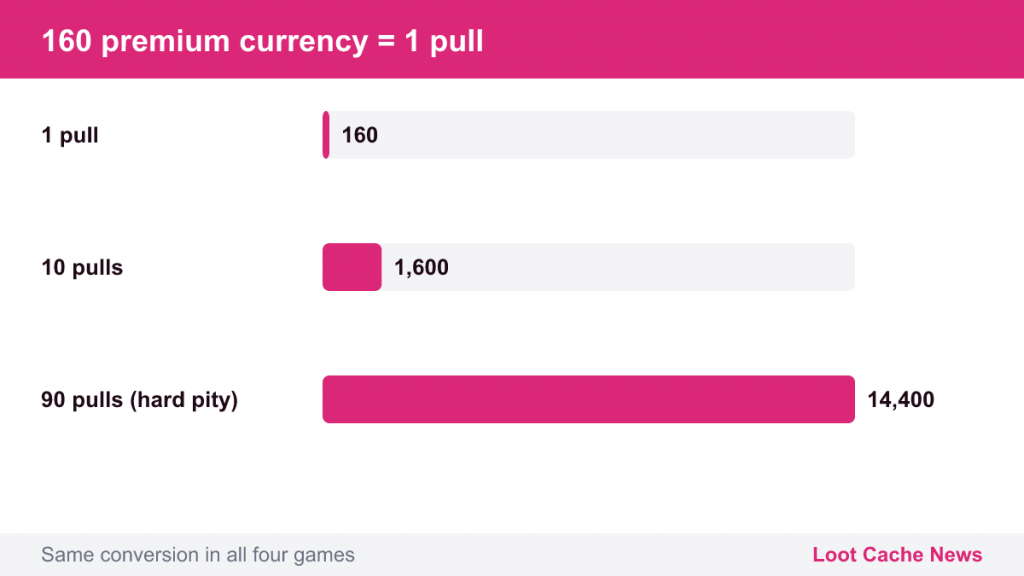
All four games use the same conversion at the heart of their pull economy: 160 units of premium currency buy one pull ticket, so a ten-pull costs 1,600. That shared number makes it easy to compare progress across games once you know the local names.
| Game | Free premium currency | Paid currency (1:1) | Limited ticket | Standard ticket |
|---|---|---|---|---|
| Genshin Impact | Primogems | Genesis Crystals | Intertwined Fate | Acquaint Fate |
| Honkai: Star Rail | Stellar Jade | Oneiric Shards | Star Rail Special Pass | Star Rail Pass |
| Zenless Zone Zero | Polychromes | Monochrome | Encrypted Master Tape | Master Tape |
| Wuthering Waves | Astrite | Lunite | Radiant Tide (characters), Forging Tide (weapons) | Lustrous Tide |
In Genshin, Star Rail and Zenless Zone Zero the limited ticket covers both the featured character banner and the featured weapon-type banner (Epitomized Path, Light Cone warps, W-Engine channel). Wuthering Waves separates them: Radiant Tides are used on the featured character Convene and Forging Tides on the featured weapon Convene. In every game the standard ticket only works on the permanent banner and, where it exists, the beginner banner.
The 160 figure is also why pity counts are best translated into currency. If a game’s hard pity for a 5-star on a character banner is 90 pulls, the worst-case currency cost of reaching it from zero is 90 × 160 = 14,400 premium currency. Our pity systems explainer goes into those ceilings in more detail.
Free premium currency: where most players live
The first column of the table is what most players actually deal with. Primogems, Stellar Jade, Polychromes and Astrite are handed out for completing story chapters, opening chests, finishing events, clearing recurring endgame modes, logging in during special campaigns and as compensation after maintenance.
Because the free currency trickles in over time, the key habit is to measure a banner in weeks of play rather than in currency. If you know roughly how much you earn per version, a ten-pull stops being an abstract 1,600 and becomes “about this many weeks of daily commissions and events”. That framing also makes it much easier to skip banners you only half want. And whether you are looking at 3,200 Astrite or 3,200 Primogems, it is twenty pulls: the names are branding, the math is identical.
Paid currency: the layer that hides real money
The paid-only currencies (Genesis Crystals, Oneiric Shards, Monochrome and Lunite) are the layer that matters most for spending awareness. They are bought in fixed packs, converted into free premium currency, and then converted again into tickets. That gives the player at least two conversion steps between a dollar amount and an actual pull.
Several design details make that chain hard to track:
- Pack sizes do not divide evenly into pulls. Packs come in amounts that rarely equal exact multiples of 160, so after a purchase there is usually a remainder that is “almost” another pull.
- First-purchase bonuses double some packs the first time they are bought, which makes the per-pull price vary from purchase to purchase.
- Paid currency can buy things directly, such as cosmetic bundles, in addition to being converted. Mixing uses makes it harder to know what share of spending went to pulls.
- Prices vary by region and platform, so a figure quoted online may not match your store.
Regulators have noticed this pattern. In January 2025 the US Federal Trade Commission announced a proposed $20 million settlement with Cognosphere (the company that operates as HoYoverse) over Genshin Impact. The FTC’s complaint described a multi-tier virtual currency system with different exchange rates that obscured the real-money cost of loot boxes, and the proposed order included requirements to disclose loot box costs in real money and odds, plus a ban on selling loot boxes to children under 16 without parental consent. The practical lesson: when currencies are layered, do the conversion yourself.
How to translate a purchase back to real money
If you ever consider buying paid currency, the honest calculation is simple and worth doing on paper before you open the shop:
- Take the pack price in your local store and the amount of paid currency it gives (ignore first-purchase bonuses, which only apply once).
- Divide the amount by 160 to get the number of pulls.
- Divide the price by that number to get the price per pull.
- Multiply by the worst-case pity count you would need to reach, not the best case.
That last step turns a cheerful “ten-pull” into the maximum cost of a specific character, the number that belongs in any budget. Our guide to setting a spending limit, including a limit of zero, walks through building that into a monthly plan.
Exchange shops: the currencies you get from duplicates
Every pull that lands on a weapon or a duplicate character gives back some secondary currency. These pile up quietly and can be traded in a dedicated shop for tickets, upgrade materials and occasionally specific 4-star characters. They are an often overlooked by-product of pulls you already made.
| Game | Exchange currencies | Shop | Ticket exchange (as reported in guides, 2024–2025) |
|---|---|---|---|
| Genshin Impact | Masterless Starglitter, Masterless Stardust | Paimon’s Bargains | 5 Starglitter per Fate; Stardust exchanges capped monthly |
| Honkai: Star Rail | Undying Starlight, Undying Embers | Embers Exchange / Starlight Exchange | 20 Undying Starlight per Pass, limited monthly stock |
| Zenless Zone Zero | Residual Signal, Fading Signal | Signal Shop | 20 Residual Signal per Encrypted Master Tape; Fading Signal tapes capped monthly |
| Wuthering Waves | Afterglow Coral, Oscillated Coral | Item exchange shop | 8 Afterglow Coral per Tide; Oscillated Coral exchanges limited |
The higher-value currency in each pair (Starglitter, Starlight, Residual Signal, Afterglow Coral) comes from rarer duplicates and is usually the one that buys limited tickets. The lower-value one (Stardust, Embers, Fading Signal, Oscillated Coral) comes from common 3-star items and tends to have monthly purchase caps. Exact limits and prices can change between versions, so check the in-game shop rather than relying on old screenshots.
Do not forget the shop resets
Most of these shops restock monthly. Checking the exchange shop at the start of each month is a low-effort habit that adds a few pulls over a year without any spending.
Why layered currencies change how you think
None of these layers is hidden; the issue is psychological. Behavioural economists describe a “mental accounting” effect: people treat money differently depending on which mental bucket it sits in. Each conversion, from cash to crystals to tickets, moves spending further from the dollars that started it.
A few practical counter-habits help keep the chain visible:
- Keep a running note in real-world units. If you ever spend, write down the amount in your own currency, not in crystals or shards.
- Do not top up to “round off” a remainder. Leftover paid currency that is a few dozen short of a pull is a classic nudge toward one more purchase. Treat the remainder as sunk and let free currency fill the gap.
- Price pulls in time, too. Translate any banner into weeks of free earnings. Patience is a currency the game also accepts.
- Use platform spending limits. PlayStation, Xbox, Steam and Epic all offer account-level controls. Our parental controls guide explains where they live, and they work just as well for adults setting a personal cap.
Common mistakes with gacha currencies
Most currency mistakes come from not knowing which layer an item belongs to:
- Buying the wrong ticket. The standard ticket cannot be used on limited banners. If you convert premium currency into standard tickets by accident, you cannot undo it. Always double-check the icon before confirming.
- Spending premium currency on stamina. Refilling stamina with Primogems, Stellar Jade, Polychromes or Astrite is possible, but the same currency would otherwise become pulls. Free stamina regeneration is enough for steady progress.
- Ignoring free tickets from events. Many events reward standard or limited tickets directly. They often sit unnoticed in the inventory.
- Treating paid currency as “free” after a top-up. Once it is in the account, it looks identical to earned currency. Separating the two in your own notes keeps spending honest.
Quick answers
Is the paid currency ever necessary?
No. All four games let you play the full main story without buying anything, and every banner can be pulled on with free premium currency. Paid currency is optional.
Do paid and free currencies have the same value?
For pulls, yes: the paid currency converts 1:1 into the free one, and both reach a ticket at 160. Some games also let paid currency buy items that free currency cannot, such as certain cosmetics or monthly passes.
Can currency move between platforms?
Progress on one account usually syncs across platforms, but some paid currency balances can be restricted to the platform where they were bought. Check each game’s official FAQ before assuming a balance will follow you to another device.
Every number in a gacha shop traces back to the same chain: earned or bought currency, 160 to a pull, and a pity ceiling that tells you the worst case. Keep that chain in view and the decision about whether to pull, wait or skip stays yours.