Demon Slayer Games Explained: The Hinokami Chronicles Series
Both Demon Slayer: The Hinokami Chronicles games explained: which anime arcs each adapts, how story and versus modes work, platforms and age ratings.

Demon Slayer: Kimetsu no Yaiba became one of the biggest anime of its era, and its main home on PC and console is a two-game series called The Hinokami Chronicles. Both games are developed by CyberConnect2, the Japanese studio behind the long-running Naruto: Ultimate Ninja Storm series, and both aim to recreate the anime’s look and its big fights as closely as possible.
This guide explains what each game covers, how its story mode is structured, what the versus mode offers, which platforms it runs on and how it is rated. It is written for fans deciding where to start, not as a combat or competitive guide.
The series at a glance
| The Hinokami Chronicles | The Hinokami Chronicles 2 | |
|---|---|---|
| Developer | CyberConnect2 | CyberConnect2 |
| Publishers | Aniplex (Japan), Sega (worldwide) | Aniplex (Japan), Sega (worldwide) |
| Release | October 2021 (PS4, PS5, Xbox One, Xbox Series X|S, PC); June 2022 (Switch) | August 2025 (PS4, PS5, Xbox One, Xbox Series X|S, PC, Switch); August 5, 2025 in North America and Europe |
| Story coverage | Anime season 1 (Unwavering Resolve Arc) and the Mugen Train film | Entertainment District, Swordsmith Village and Hashira Training arcs |
| ESRB | T (Teen) | M (Mature 17+) |
| PEGI | 16 | Check the PEGI database for your platform |
Both games have two main parts: a single-player story mode that retells anime arcs, and a versus mode where players pick characters and battle the computer or other players locally and online.
Who makes the games: CyberConnect2’s anime approach
CyberConnect2 has built a reputation for adapting anime with unusual faithfulness. Its Naruto games turned famous fights into playable set pieces with camera angles and effects matching the show, and it later developed Dragon Ball Z: Kakarot. The Hinokami Chronicles applies the same approach to Demon Slayer, whose anime, produced by studio ufotable, is known for its striking visual effects, especially the water and flame effects of the Breathing techniques.
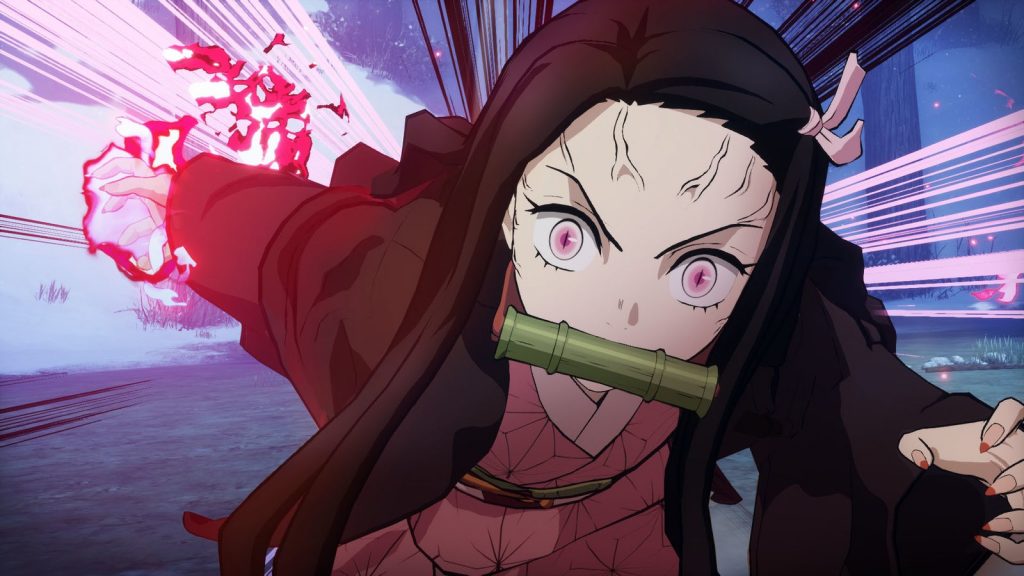
The games recreate those effects with a cel-shaded style built in Unreal Engine 4 for the first game. Iconic scenes are often staged almost shot for shot, and the original Japanese voice cast is included. For fans, this presentation is the main draw: it lets you step into scenes you already know.
The Hinokami Chronicles (2021): from the start to Mugen Train
The first game adapts the beginning of the story. Its story mode, often called Adventure Mode, follows Tanjiro Kamado from the attack on his family and his decision to become a demon slayer through Final Selection, his first missions, the battle at Mount Natagumo and the events of the Mugen Train film.
How the story mode is structured
The story is split into chapters that mix several kinds of play:
- Exploration sections, where Tanjiro walks through locations from the anime, talks to characters and finds collectibles, including items that unlock extras like character art and scenes.
- Cutscenes retelling key moments from the anime.
- Boss battles against the arc’s major demons, which escalate into cinematic sequences with button prompts recreating the show’s climactic moments.
- Smaller battles against lesser demons between story beats.
The story is mostly told from Tanjiro’s perspective, with some sections featuring other characters. It is a fairly linear experience and can be completed without online play.
Versus mode and roster
In versus mode, players form two-character teams and fight in arenas drawn from the anime. The first game launched with 18 playable characters and grew to 31 through free updates and paid DLC. Free updates added popular characters such as Akaza and Rui, while a paid Additional Character Pack in 2022 added seven characters from the Entertainment District Arc. That meant those characters were playable in versus mode even though the Entertainment District story itself was not part of the first game’s story mode.
The game was the best-selling retail title in Japan in its launch week, and Sega later reported sales of 4 million copies worldwide.
The Hinokami Chronicles 2 (2025): Entertainment District to Hashira Training
The sequel picks up where the first game left off. Its story mode covers three arcs that followed Mugen Train in the anime:
- Entertainment District Arc, in which Tanjiro, Zenitsu and Inosuke go undercover with the Sound Hashira, Tengen Uzui, to track down a demon hiding in the pleasure district.
- Swordsmith Village Arc, centred on the hidden village of swordsmiths and an attack on it by Upper Rank demons.
- Hashira Training Arc, in which the Demon Slayer Corps’ strongest swordsmen train the rank-and-file in preparation for the final battles.
The sequel was released in Japan on August 1, 2025 and in North America and Europe on August 5, 2025, on PS5, PS4, Xbox Series X|S, Xbox One, PC (Steam) and Nintendo Switch. Its roster expands considerably, including all nine Hashira, the characters from the first game, and the Entertainment District characters that had been DLC.
Anyone following the anime will notice the timing: the sequel’s story ends where the anime’s final arc, the Infinity Castle story, begins. That arc is being adapted as a film trilogy starting in 2025, so it is not part of the sequel’s base story.
Which game should you start with?
- If you are new to Demon Slayer or want the story in order: start with the first game. It covers the opening of the story and the Mugen Train film.
- If you have already watched up to the Hashira Training Arc and mainly want versus battles: the sequel has the larger roster and covers the later arcs.
- If you want to experience the story without spoilers for later arcs: play them in order, since the sequel’s story assumes you know what happened in the first.
If you are matching the games to the anime, the mapping is straightforward. The first game corresponds to the first TV season and the Mugen Train story (released as a film in 2020 and later as a TV arc). The sequel corresponds to the following three TV arcs: the Entertainment District Arc (2021–22), the Swordsmith Village Arc (2023) and the Hashira Training Arc (2024). A fan who has watched up to a given arc can play the matching chapters without worrying about spoilers beyond it.
Neither game is a substitute for watching the anime. Both compress arcs into chapters, and some quieter character moments are summarised or skipped. They work best as a companion to the show, letting you relive its biggest moments.
Age ratings: why the two games are rated differently
The two games carry noticeably different ratings in North America, which surprises some parents.
- The first game is rated T (Teen) by the ESRB, with descriptors for Blood and Gore, Language and Violence. In Europe, PEGI rates it 16 for sustained depictions of violence.
- The sequel is rated M (Mature 17+) by the ESRB, with descriptors for Blood and Gore, Language, Suggestive Themes and Violence. The ESRB’s summary notes that many enemy defeats show decapitations, often with close-up camera angles or slow motion, that some female characters wear revealing outfits, and that some dialogue is sexually suggestive. It also carries an In-Game Purchases notice.
Demon Slayer’s anime itself contains graphic violence, so this should not come as a total surprise, but the jump from T to M is worth knowing about for families. Our guide to ESRB and PEGI ratings explains how the systems work and why ratings can differ between regions.
DLC and purchases
Like most licensed fighting and action games, the Hinokami Chronicles games are traditional paid releases. Additional characters come as free updates or as fixed-price paid packs, so you always know what you are getting, unlike the randomised pulls of gacha games. Sequel editions with extra characters and pre-order unlocks also exist.
A few practical points:
- The base game is complete. The full story mode is in the base game, and DLC characters are mostly for versus mode.
- Bundles and complete editions often appear later. Waiting is a perfectly reasonable choice if you only want the story.
- Family settings apply. Platform purchase controls work for DLC as well; see our parental controls guide for where to find them.
How these games compare with other anime adaptations
The Hinokami Chronicles sits somewhere between a full story game and a dedicated versus fighter. Compared with Dragon Ball Z: Kakarot, which is a large single-player RPG, its story mode is shorter and more linear. Compared with arena fighters such as Dragon Ball: Sparking! Zero, its roster is smaller but its story presentation is more cinematic. Our Dragon Ball games guide explains those other formats.
What sets the series apart is its focus. It covers one story in order, arc by arc, with a strong emphasis on matching the anime’s direction. For fans who want to relive the anime in an interactive form, that makes it one of the more faithful adaptations available.
Quick answers
Do I need to play the first game before the sequel?
Not to understand the controls, but the sequel’s story continues directly from the first, so playing in order is best if you care about the narrative.
Can I play the story mode offline?
Yes. Story modes in both games are single-player. Online play is needed only for online versus matches.
Does either game cover the Infinity Castle?
Not in the base story. The sequel ends with the Hashira Training Arc, which leads into the Infinity Castle story being told in the film trilogy.
Are these gacha games?
No. Both are premium games with fixed-price DLC. There are no randomised pulls for characters.