Gacha Glossary: Key Terms From Pity to Constellations
An A to Z of gacha terms, from pity, rate-up and the 50/50 to C0, E0, M0, rerolls and power creep, with the names each major game uses.
Gacha communities have their own vocabulary, and it can make guides, videos and forum threads hard to follow when you are new. Some terms are universal, some are borrowed from Japanese, and some are invented by each game’s community. This glossary collects the ones you will see most often in discussions of Genshin Impact, Honkai: Star Rail, Zenless Zone Zero and Wuthering Waves, with short, plain definitions and the game-specific names where they differ.
Where a term deserves a longer explanation, we link to the full explainer. Terms are grouped by theme, then listed alphabetically within each group, so related ideas sit together.
Pulling and banners
Banner. A limited or permanent pool of items you can pull from, usually advertised with featured characters or weapons. Each game names its pulls differently: Wishes in Genshin Impact, Warps in Honkai: Star Rail, Signal Search in Zenless Zone Zero and Convenes in Wuthering Waves. Our guide to limited vs standard banners covers how they work.
Beginner banner. A one-time banner for new accounts, usually with a discount or a guaranteed reward after a set number of pulls. It disappears once completed.
Limited banner. A banner available only for a set period, typically part of a game version, featuring one or more rate-up characters or weapons.
Pull (or roll, summon). One attempt on a banner, consuming one ticket. A ten-pull is ten attempts at once. In the major HoYoverse and Kuro Games titles, ten pulls cost the same as ten single pulls.
Rate-up. A featured item whose chance of appearing is increased compared with the rest of the pool at that rarity. “Rate-up” does not mean a high chance overall; it means a higher share of the results at that rarity.
Rerun. The return of a previously featured limited character or weapon on a later banner. Knowing that reruns happen reduces the pressure to pull before a timer runs out, although rerun timing is never guaranteed.
Standard banner (permanent banner). A banner that never goes away, with a fixed pool of characters and weapons. It uses its own ticket type.
Ticket. The item actually consumed by a pull. In all four games, one ticket costs 160 units of the premium currency. See gacha currencies explained for the full conversion chain.
Odds, pity and guarantees
50/50. When you get a top-rarity result on a limited character banner, many games give an even chance that it will be the featured character. If it is not, you “lose the 50/50” and receive a standard-pool character instead. The rules differ between games and banner types.
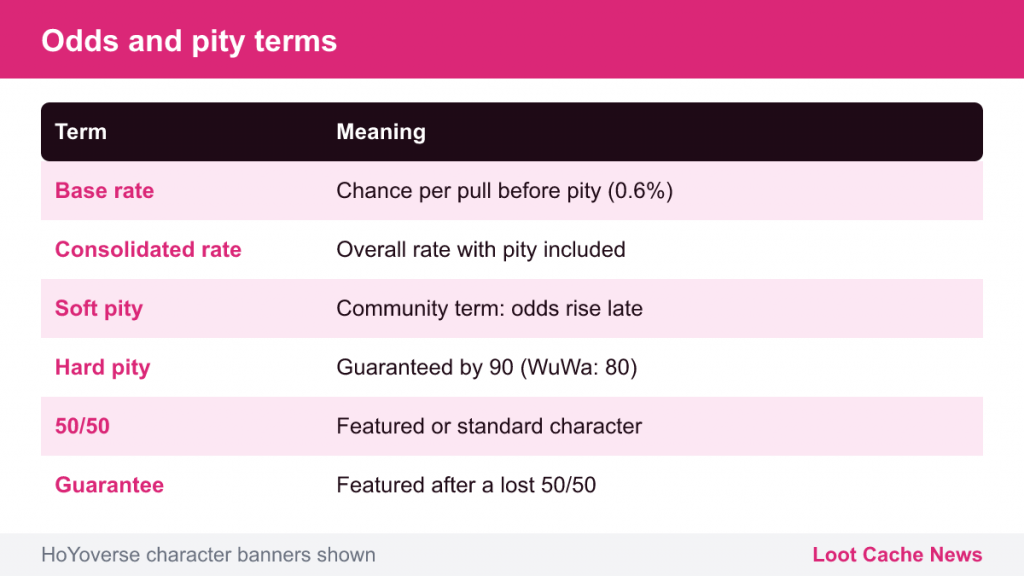
Base rate. The published probability of getting a given rarity on any single pull, before pity is taken into account. The 5-star base rate on HoYoverse character banners is 0.6%.
Capturing Radiance. A mechanic added to Genshin Impact’s character banners in 2024 that gives players who lose the 50/50 a chance to receive the featured character anyway under certain conditions.
Consolidated rate. The overall probability of getting a given rarity once pity is included, averaged over many pulls. It is higher than the base rate and is also published on official details pages.
Gambler’s fallacy. The mistaken belief that a random event becomes more likely because it has not happened for a while. Outside of pity mechanics, each pull is independent; a long dry streak does not make the next pull luckier on its own.
Guarantee. After losing a 50/50, the next top-rarity result on that banner type is guaranteed to be the featured item. The guarantee usually carries over to future banners of the same type.
Hard pity. The maximum number of pulls before a top-rarity result is guaranteed. On HoYoverse character banners this is 90 pulls; in Wuthering Waves it is 80. Our pity systems explainer treats hard pity as a worst-case cost ceiling for budgeting.
Pity counter. The number of pulls since your last top-rarity result on a banner type. Most games carry the counter over to the next banner of the same type.
Soft pity. A community term for the point at which the chance of a top-rarity result starts rising sharply before hard pity. The exact mechanics are usually inferred from player data rather than fully published.
Duplicates and upgrades
C0, E0, M0, S0. Shorthand for owning a character with no duplicate copies: C0 (Constellation 0) in Genshin, E0 (Eidolon 0) in Star Rail, M0 (Mindscape 0) in Zenless Zone Zero and S0 (Resonance Chain sequence 0) in Wuthering Waves. A base-copy character is fully usable for all story content.
Constellations (Genshin Impact). Upgrades unlocked by duplicate copies of a character, from C1 to C6.
Dupes. Duplicate copies of a character or weapon. Depending on the game, duplicates unlock upgrades or are converted into an exchange currency.
Eidolons (Honkai: Star Rail). Star Rail’s equivalent of Constellations, E1 to E6.
Mindscape Cinema (Zenless Zone Zero). ZZZ’s duplicate upgrades, M1 to M6.
Refinement, Superimposition, Phase and Rank. Weapon duplicate upgrades: Refinement (R1 to R5) in Genshin, Superimposition (S1 to S5) for Light Cones in Star Rail, W-Engine Phase in Zenless Zone Zero, and weapon Rank in Wuthering Waves.
Resonance Chain (Wuthering Waves). Wuthering Waves’ duplicate upgrades, with six nodes.
Signature weapon. A weapon designed with a particular character in mind, usually released alongside them on a weapon banner. Helpful but almost never required; skipping weapon banners is common and reasonable.
Duplicates are the main reason high spending exists in gacha games. Each copy costs the same as the first, with the same odds, so a fully upgraded character can cost many times what a single copy does. Knowing this makes it easier to decide that one copy is enough.
Currencies and resources
Exchange currency. A secondary currency received from duplicates and low-rarity results, such as Masterless Starglitter, Undying Starlight, Residual Signal or Afterglow Coral, which can be traded for tickets and other items in a shop.
Paid currency. A currency sold only for real money (Genesis Crystals, Oneiric Shards, Monochrome, Lunite) that converts 1:1 into the free premium currency.
Premium currency. The currency that buys pull tickets: Primogems, Stellar Jade, Polychromes and Astrite. It is earned through play and can also be obtained by converting paid currency.
Stamina. A resource that regenerates over real time and is spent to claim rewards from repeatable activities: Original Resin, Trailblaze Power, Battery Charge and Waveplates.
Monthly pass. A low-cost purchase that grants a small daily amount of premium currency over about 30 days, provided you log in. Examples include Genshin’s Blessing of the Welkin Moon and Star Rail’s Express Supply Pass. They are optional, and many players never buy them.
Player and community terms
Dolphin, low spender. Informal terms for players who spend modest amounts. Like “whale”, they describe spending patterns, not skill or worth.
F2P (free-to-play). Strictly, a player who has spent nothing. All four major games covered here can be completed without spending. Community “F2P-friendly” labels usually mean a character or team that performs well without duplicates or signature weapons.
Meta. The set of characters and teams considered strongest at a given time, usually for difficult endgame modes. The meta changes with every new release and is irrelevant to most story and exploration content.
Reroll. Creating a new account repeatedly until the early free pulls produce a desired character. It is time-consuming, and some games make it harder by tying accounts to emails or adding beginner guarantees.
Tier list. A community ranking of characters. Useful as a rough guide, but tier lists reflect specific endgame conditions and opinions, and they shift often.
Whale. A term, borrowed from casino jargon, for a player who spends very large amounts. It is worth treating critically: it normalises heavy spending as a personality type, even though in many gacha games a large part of revenue comes from a very small proportion of players. Problematic spending is a real risk, and if spending ever feels out of control, our guide to setting a spending limit lists warning signs and where to find help.
Live-service and design terms
Banner phase. A version is often divided into two phases, each with its own featured characters.
FOMO (fear of missing out). The anxiety that time-limited content creates. Many design choices, from banner timers to limited events, rely on it. Recognising it is the first step to resisting it.
Livestream. An official broadcast before each new version that previews upcoming content and usually includes redemption codes for small amounts of free premium currency.
Maintenance compensation. Free premium currency given to players after scheduled server maintenance or to apologise for bugs.
Power creep. The gradual rise in the strength of newly released characters relative to older ones. It can make older characters feel weaker in endgame modes, though most story content remains comfortably clearable.
Redemption code. A code entered in-game or on an official website to claim free rewards. Only use codes from official sources; “free currency” generators and sites asking for login details are scams.
Version (patch). A content update, often on a cycle of roughly six weeks, that brings new story chapters, events and banners.
Terms that sound similar but mean different things
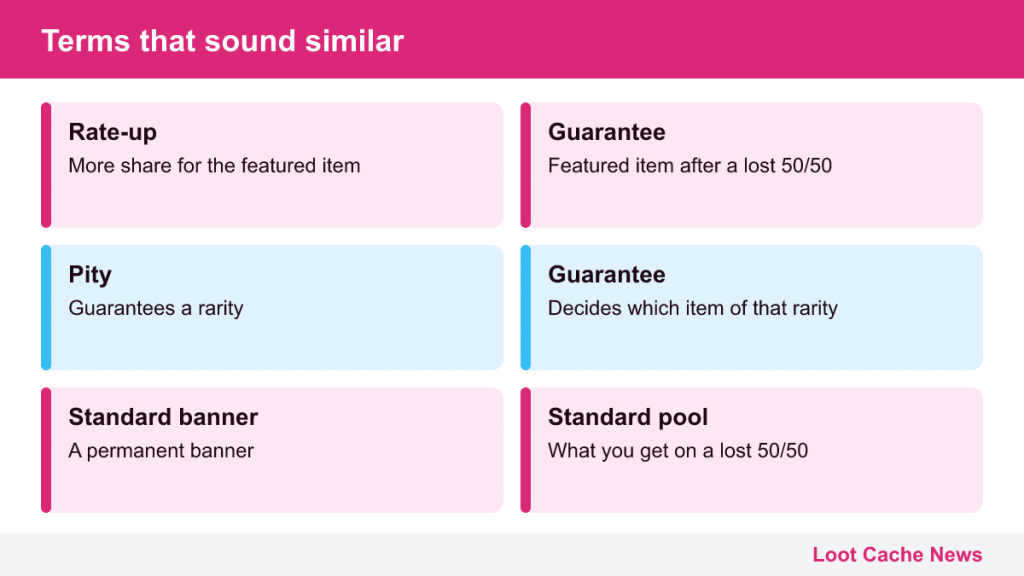
- Rate-up vs guarantee. A rate-up increases the share of results for a featured item; a guarantee ensures it after a lost 50/50.
- Pity vs guarantee. Pity guarantees a rarity after a set number of pulls; a guarantee guarantees which item of that rarity you get.
- Standard banner vs standard pool. The standard banner is a permanent banner; the standard pool is the set of characters you can receive when you lose a 50/50.
- F2P vs F2P-friendly. The first describes a player; the second describes a character or team.
A note on language and pressure
Gacha vocabulary can make spending sound routine. Phrases like “just go for the guarantee” or “it’s only a few pulls to pity” turn real costs into game jargon. A useful habit is to translate any term back into its plain meaning: a guarantee after a lost 50/50 can mean up to twice the hard pity, and every pull has a real-time or real-money cost. Clear language keeps decisions clear.