Gacha Game Age Ratings Explained: ESRB, PEGI and In-Game Purchase Labels
How ESRB and PEGI rate gacha games like Genshin Impact and Honkai: Star Rail, what the random-items label means, and PEGI's 2026 rule changes.

Age ratings are the first thing many parents check before a new game arrives in the house, and they are also one of the most misunderstood. A “Teen” or “12” label tells you a lot about what a game shows: its violence, language and suggestive content. Traditionally it told you much less about how the game makes money. For gacha games, which are free to download and built around randomized purchases, that gap matters.
This guide explains how the two main rating systems for North America and Europe, the ESRB and PEGI, handle the major gacha games on PC and console, what the in-game purchase notices mean, why a rating is not a measure of monetization intensity, and how PEGI’s 2026 rule changes have started to address that.
The Two Rating Systems in Brief
ESRB (North America)
The Entertainment Software Rating Board assigns ratings in the United States and Canada. Its ratings run from E (Everyone) through E10+, T (Teen), M (Mature 17+) and AO (Adults Only 18+). According to the ESRB’s guide, Teen content is generally suitable for ages 13 and up and may contain violence, suggestive themes, crude humor, minimal blood, simulated gambling and infrequent strong language.
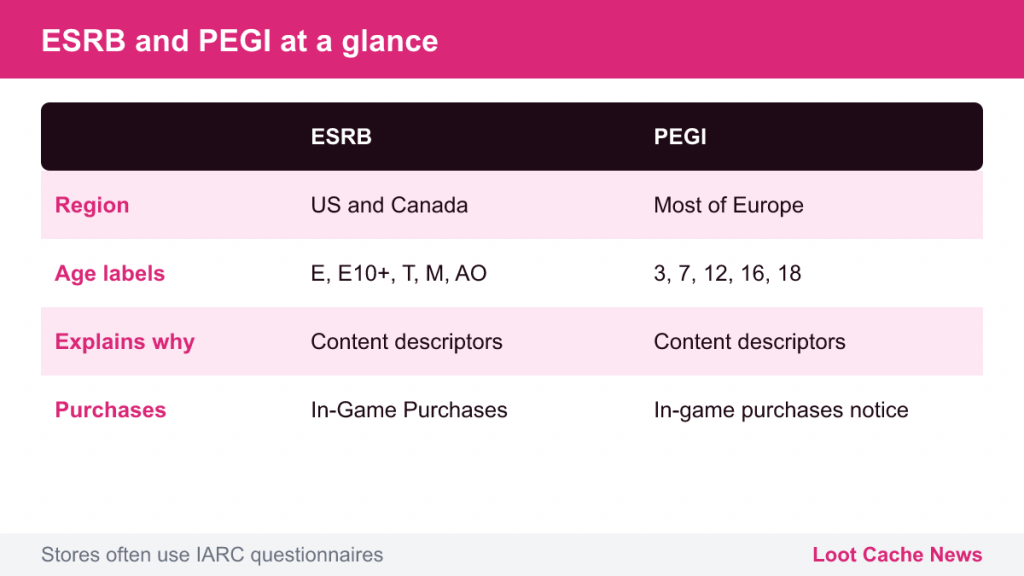
Each rating has three parts: the rating category, content descriptors that explain why the rating was given (for example “Fantasy Violence” or “Suggestive Themes”), and interactive elements that describe features outside the game’s content, such as “Users Interact” or “In-Game Purchases”.
PEGI (Europe)
Pan European Game Information is used in most of Europe. Its age labels are 3, 7, 12, 16 and 18, accompanied by content descriptors such as violence, bad language or gambling, and a separate notice for in-game purchases. Some countries use their own systems instead or alongside it; Germany, for example, uses USK.
Digital storefronts and app stores often rely on the International Age Rating Coalition (IARC) process, which issues ratings from the relevant regional bodies based on a questionnaire. That is one reason the same game can show slightly different ratings or descriptors in different stores and regions.
How the Major Gacha Games Are Rated by the ESRB
The table below lists the ESRB ratings and descriptors for the major PC and console gacha games covered on this site, as shown on the ESRB’s own rating pages in October 2026. Descriptors can differ slightly between platform listings of the same game.
| Game | ESRB rating | Content descriptors | Interactive elements |
|---|---|---|---|
| Genshin Impact | T (Teen) | Fantasy Violence, Mild Language, Mild Suggestive Themes, Use of Alcohol | Users Interact, In-Game Purchases (Includes Random Items) |
| Honkai: Star Rail | T (Teen) | Fantasy Violence, Mild Suggestive Themes, Simulated Gambling | In-Game Purchases (Includes Random Items); Users Interact on the PC listing |
| Zenless Zone Zero | T (Teen) | Mild Blood, Mild Language, Suggestive Themes, Violence | Users Interact, In-Game Purchases (Includes Random Items) |
| Wuthering Waves | T (Teen) | Mild Language, Suggestive Themes, Violence | Users Interact, In-Game Purchases (Includes Random Items) |
| Arknights: Endfield | T (Teen) | Mild Language, Suggestive Themes, Violence | Users Interact, In-Game Purchases (Includes Random Items) |
Two details stand out. First, every game on the list is rated Teen, which reflects broadly similar content: stylized combat, occasional mild language and character designs that the ESRB describes as suggestive. Second, Honkai: Star Rail carries a “Simulated Gambling” descriptor. According to the ESRB’s rating summary, that refers to an in-game slot-machine-style activity played with tokens, not to the warp (gacha) system itself.
What “In-Game Purchases (Includes Random Items)” Means
The ESRB introduced the “In-Game Purchases” interactive element in 2018 and added the more specific “In-Game Purchases (Includes Random Items)” notice in April 2020. The random-items version applies when a game sells, for real money or for a premium currency that can be bought with real money, items whose exact contents the buyer does not know in advance. That covers loot boxes, card packs and gacha pulls.
Every game in the table carries it, which is the expected result for gacha games. For parents, the notice is a practical signal: this game sells randomized items, so it is worth reviewing the spending controls on your platform before handing over the controller. Our guide on setting a spending limit covers the tools PlayStation, Xbox, Steam and Epic provide.
The ESRB’s definition is broad. It names gacha games explicitly, alongside loot boxes, item or card packs, prize wheels and treasure chests, and it applies whether the purchase is made directly with money or with an in-game currency that can be bought with money. PEGI uses its own in-game purchases notice alongside its age labels, and as described below, it has since gone further.
Why a Rating Does Not Measure Monetization
Historically, the age category itself (E, T, 12, 16 and so on) was based on content: what you see and hear while playing. The purchase notices sat alongside it as information, but they did not change the age number. That produced some odd results:
- A game with mild cartoon violence and aggressive randomized monetization could carry a low age rating.
- Two games with identical Teen ratings could differ enormously in how often they present limited-time offers, how expensive their worst-case pull costs are, and how much pressure their banner timers create.
- The notice says randomized purchases exist. It does not tell you the drop rates, the pity rules, or how prominently offers are shown.
For those details, you need to look inside the game: the banner details page lists the rates and guarantees, and our explainer on gacha drop rates covers how to read them. A rating label is a starting point, not a full picture.
PEGI’s 2026 Changes: Paid Random Items and the PEGI 16 Default
In March 2026, PEGI announced what legal commentators described as its most significant reform in over a decade. The new criteria apply to titles submitted for rating from June 2026 onward and introduce “interactive risk” categories that can raise the age rating itself, not just add a notice.
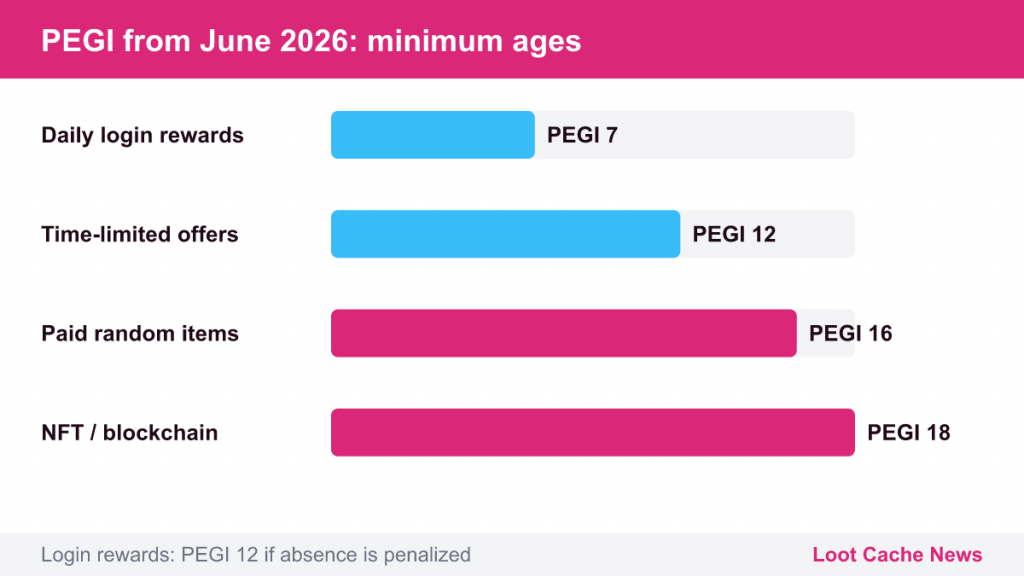
- Paid random items: games that sell items where players do not know exactly what they are getting before purchase, a definition that explicitly includes gacha systems, loot boxes, card packs and prize wheels, receive a minimum rating of PEGI 16 by default.
- Time-limited or quantity-limited offers: trigger a minimum of PEGI 12.
- Play-by-appointment features: rewards for returning, such as daily login streaks, trigger a minimum of PEGI 7, rising to PEGI 12 if the game penalizes absence.
- NFT and blockchain mechanics and entirely unrestricted communication features lead to PEGI 18.
Commentary on the reform states that games already classified will generally not be re-rated unless their content updates require reclassification, though reports differ on how and when existing titles may be reviewed. The practical upshot: the PEGI label you see on a long-running gacha game may still reflect its original rating, while a new gacha game rated after June 2026 is likely to show PEGI 16 or higher. Check the PEGI listing or the store page in your region for the current label.
This is a notable shift. Under the new approach, a gacha mechanic is itself treated as a reason a game may be unsuitable for younger teenagers, regardless of how mild its content is.
Why the Same Game Can Show Different Ratings
Parents comparing listings often find inconsistencies. A few reasons explain most of them:
- Different systems. ESRB, PEGI, USK and others use different criteria and age bands, so “T” and “12” are not exact equivalents.
- Different platforms. Separate listings for PC, PlayStation, Xbox and mobile can be rated at different times, sometimes with slightly different descriptors.
- Updates and edits. Live-service games change over time. Developers sometimes alter character designs or content, which can affect classifications in some regions. Reports in 2025, for example, described Wuthering Waves briefly moving to a 16+ classification on some listings and then returning to 12+ after character model changes, though the exact rating body involved was not clearly reported.
- Timing of rule changes. As described above, PEGI’s 2026 criteria apply differently to new and existing submissions.
Practical Advice for Parents
- Read beyond the age number. Check content descriptors and interactive elements on the ESRB or PEGI page, or the store listing.
- Treat the random-items notice as an action item. Set up platform spending controls before play begins. On PlayStation, child accounts have a monthly spending limit of zero by default.
- Look at account requirements. Gacha games require a publisher account, and publishers set their own minimum ages and parental consent rules in their terms.
- Talk about how pulls work. Explaining pity, rates and the worst case to a teenager is often more effective than a flat ban. Our introduction to what a gacha game is is a good starting point.
- Revisit periodically. Ratings and descriptors can change as games update, and new rules like PEGI’s 2026 reform keep the landscape moving.
Quick FAQ
Is a gacha game legally gambling because it has a random-items label?
No. The label is a consumer notice, not a legal classification. Whether paid random items count as gambling is decided by national laws, which vary by country, and most places do not treat gacha as gambling.
Does a Teen rating mean the game is fine for every 13-year-old?
A rating is guidance about content, not a verdict on a specific child. Parents know their own children best; the descriptors and the purchase notice help you decide, along with any account age rules the publisher sets.
Where can I check a rating myself?
The ESRB website has a searchable database with rating summaries for each listing. In Europe, the PEGI website and the store page for your region show the current label and descriptors.