What Is a Gacha Game? How the Model Works on PC and Console
A plain-language explanation of gacha games: free base game, randomized pulls, banners, premium currency and why the model now lives on PC and consoles.
If you have seen people talk about “pulling” for a character, “pity” or a “banner” that ends next week, you have run into a gacha game. The term covers a large group of free-to-play titles in which some of the most desirable characters and items are obtained through randomized draws rather than bought directly. For years the model was associated almost entirely with phones. Today some of the best-known examples, including Genshin Impact, Honkai: Star Rail, Zenless Zone Zero and Wuthering Waves, run on PC and PlayStation 5 as well, and several are also on Xbox.
This guide explains what a gacha game actually is, where the name comes from, how the moving parts fit together, and what to keep in mind before you start. It is written to explain, not to sell: you can understand, and enjoy, these games without ever spending money on them.
Where the Word “Gacha” Comes From
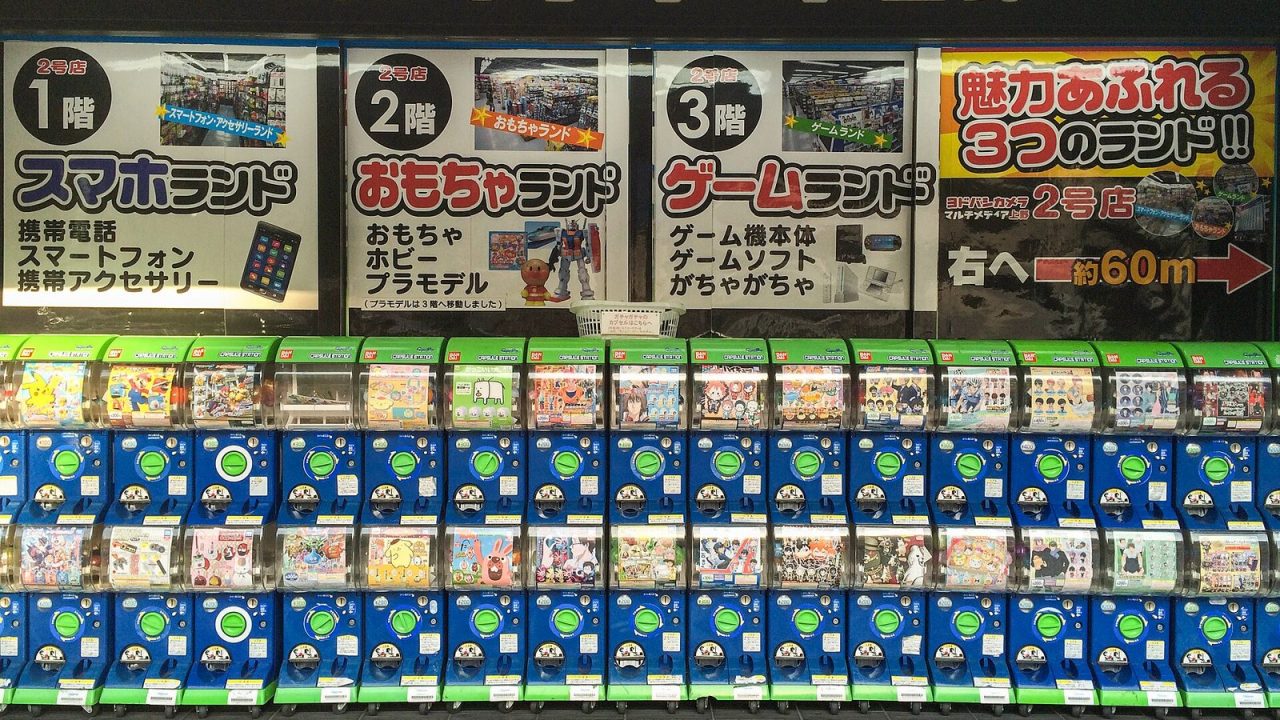
The word comes from Japanese capsule toy machines, known as gachapon or gashapon. You put coins in, turn a handle, and a plastic capsule drops out with a random toy from a themed set. The name is usually explained as imitating the sound of the crank turning (“gacha”) and the capsule dropping out (“pon”).
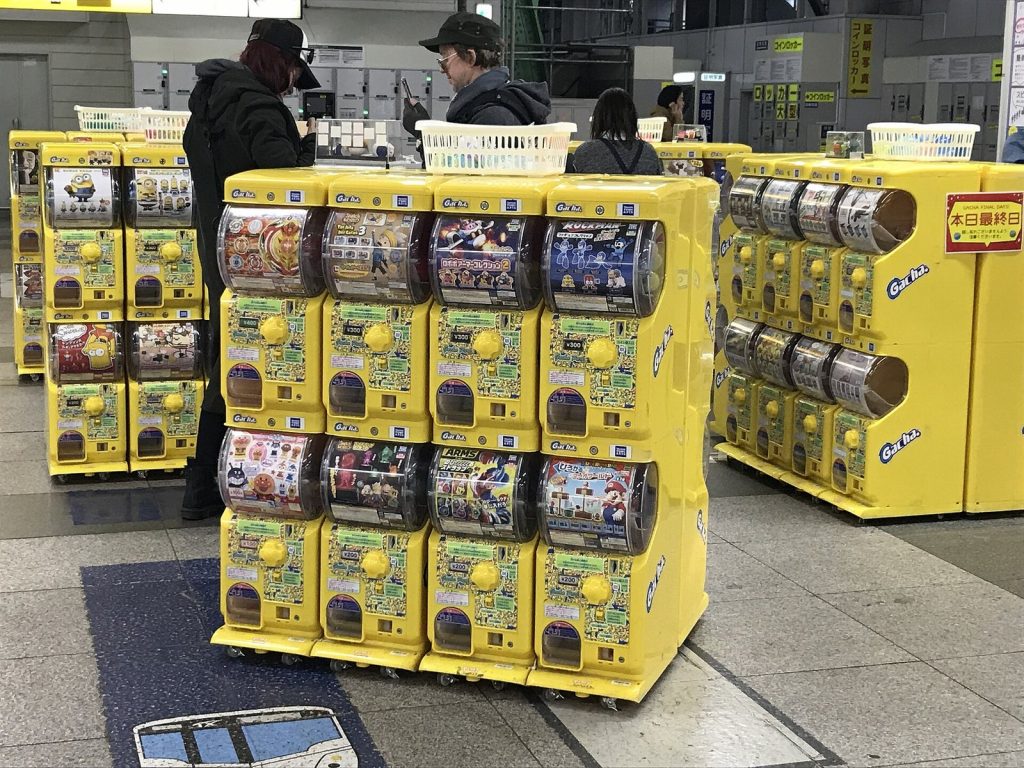
The appeal of the physical machines is easy to recognize: you know which set of toys is inside, but not which one you will get. Mobile game developers in Japan borrowed the idea in the late 2000s and early 2010s, replacing the coins with in-game currency and the toys with characters, cards or equipment. The word stuck, and “gacha” is now used worldwide for any game built around this kind of randomized draw.
The Core Loop: How a Gacha Game Is Put Together
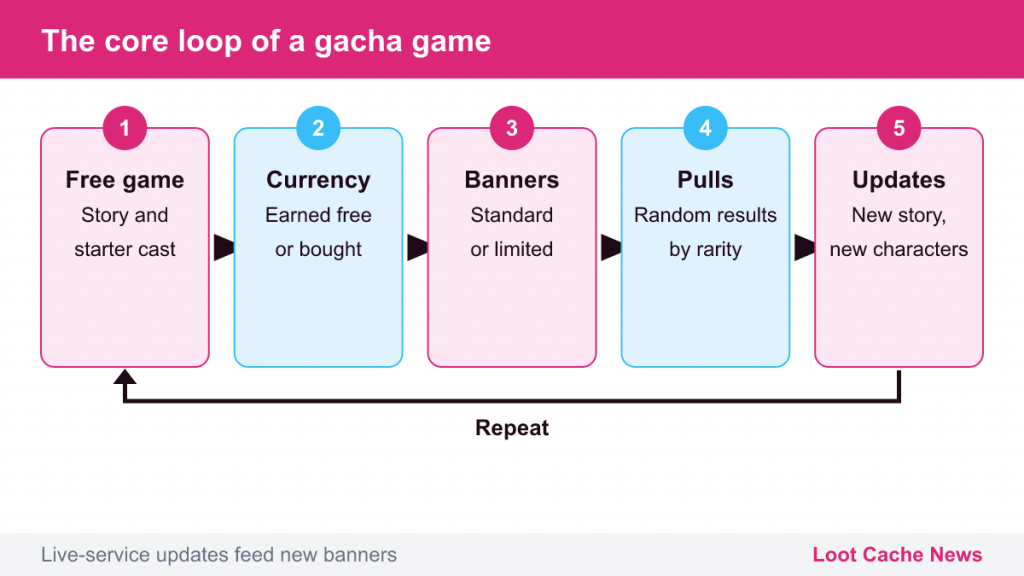
Most gacha games share a similar structure, even when the gameplay itself is completely different. An open-world action game like Genshin Impact and a turn-based game like Honkai: Star Rail feel nothing alike to play, but their economies follow the same broad pattern.
A free base game
The game itself is free to download and play. You get the story, the world, a starting roster of characters and a steady stream of rewards. In the major titles covered on this site, the main story is fully playable without paying.
Randomized pulls
New characters and high-end equipment are mostly obtained through “pulls” (also called summons, wishes, warps, signal searches or convenes, depending on the game). Each pull draws a random result from a pool, and the rarest results have a low published probability. Characters are usually ranked by rarity: 5-star (or S-rank) at the top, then 4-star (A-rank), then common items.
Premium currency
Pulls cost a premium currency. That currency can be earned for free through play, and it can also be bought with real money. Most games add one or more extra layers: you convert the premium currency into pull tickets, and leftover duplicates turn into yet another currency for exchange shops. This layering is one reason it can be hard to tell what a single pull “costs” in real money, a topic we will cover in a dedicated explainer.
Banners
A banner is a specific pull pool with its own rules. Most games have a permanent standard banner and rotating limited banners that feature a particular character or weapon with an increased chance for a set period, typically a few weeks. Limited banners are the main reason timers and “last chance” messaging show up so often in these games.
Live-service updates
Gacha games are live-service games. They receive regular version updates that add story chapters, regions, events and new characters. New characters usually arrive on limited banners, so the update cycle and the banner cycle are tightly linked.
Pity, Rates and Guarantees in Brief
Because the top-rarity results are rare, most modern gacha games include a “pity” system: a counter that guarantees a top-rarity result after a fixed number of pulls without one. In Genshin Impact, for example, the published rules for the standard and character event banners state a base 5-star rate of 0.600% per wish and a guaranteed 5-star within 90 wishes, with at least one 4-star or better in every 10 wishes. Wuthering Waves uses an 80-pull guarantee for its 5-star results.
Pity matters because it turns an open-ended random process into one with a known worst case. It does not make the draws less random before that point, and it does not guarantee you a specific featured character on the first top-rarity result in every game. Many banners also use a “50/50” rule, where your first top-rarity result might be the featured character or might come from the standard pool. The full mechanics are explained in our guide to soft pity, hard pity and guarantees.
The key takeaway for a newcomer: every major game in this genre publishes its rates and pity rules on an in-game “details” or “info” page attached to each banner. Reading that page before pulling is the single most useful habit you can build.
Why Gacha Games Moved From Phones to PC and Consoles
The gacha model grew up on mobile, but the most prominent recent examples were built from the start as multi-platform games with console-quality presentation. Genshin Impact is the clearest turning point. It launched on September 28, 2020 for Windows, Android, iOS and PlayStation 4, received a dedicated PlayStation 5 version in April 2021, and arrived on Xbox Series X|S on November 20, 2024.
Other games followed the same path:
| Game | Developer | Initial release | PC and console platforms (as of October 2026) |
|---|---|---|---|
| Genshin Impact | miHoYo / HoYoverse | September 2020 | Windows, PS5, Xbox Series X|S (PS4 version being retired) |
| Honkai: Star Rail | miHoYo / HoYoverse | April 2023 | Windows, PS5 (from October 2023) |
| Zenless Zone Zero | miHoYo / HoYoverse | July 2024 | Windows, PS5, Xbox Series X|S (from June 2025) |
| Wuthering Waves | Kuro Games | May 2024 | Windows, PS5 (from January 2025), macOS, Xbox Series X|S (2026) |
| Arknights: Endfield | Hypergryph / Gryphline | January 2026 | Windows, PS5 |
All of these also run on iOS and Android. A few practical reasons explain the shift. Large 3D worlds and action combat play well with a controller on a TV. Releasing on several platforms at once widens the audience. And in most of these games, progress lives on a publisher account, so a player can often continue the same save across devices, although paid currency is sometimes tied to the platform where it was bought.
How Gacha Differs From Other Monetization Models
It helps to place gacha alongside the models you may already know:
- Premium (buy once): you pay a fixed price for the full game, with maybe some optional expansions.
- Cosmetic shops: many free-to-play games sell outfits and visual items directly at a listed price. You know exactly what you are getting.
- Battle passes and subscriptions: you pay a fixed price for a track of rewards unlocked by playing, or for a daily drip of currency. Many gacha games include these too.
- Gacha: the item you want is not sold directly. You pay for a chance at it, with the published rate and pity system defining the odds and the worst case.
That last difference is why gacha games attract more scrutiny than other free-to-play models. Japan restricted one variant, known as “complete gacha”, in 2012. China requires games to disclose drop probabilities. Some European countries have taken a hard line on paid random items in general. Regulation varies widely by country and keeps changing, so we cover it in a separate dated explainer rather than summarizing it here.
Age Ratings and Purchase Labels
Gacha games on PC and console go through the same rating systems as any other game. In North America, the ESRB rates Genshin Impact, Honkai: Star Rail, Zenless Zone Zero, Wuthering Waves and Arknights: Endfield as Teen. In Europe, PEGI ratings for these games are commonly 12, though some store listings show 16, so it is worth checking the listing for your region.
Ratings describe content such as violence, language and suggestive themes. They do not measure how intensely a game is monetized. For that, look at the interactive elements: since April 2020 the ESRB has used an “In-Game Purchases (Includes Random Items)” notice for games that sell randomized items for real money, and every gacha game listed above carries it. PEGI uses a comparable in-game purchases notice. If you are a parent, that notice is the signal to look at spending controls on the platform, which we cover in a later guide.
Common Misconceptions
“You have to pay to finish the game”
Not in the major titles discussed here. Story quests, regions and most events are open to every player. What spending changes is how quickly you can collect specific characters and upgrades, not access to the story.
“Pulling is a skill”
It is not. Each pull is a random result within published rates. Timing tricks, “lucky” days and superstitions you may see online have no effect on the outcome. The only things you control are whether you pull, on which banner, and how many times.
“Every character is equally hard to get”
Rarities, banner rules and guarantee systems differ between games and between banner types inside the same game. A character on the standard banner, a limited character and a limited weapon can have quite different worst-case costs.
“Free players can’t enjoy these games”
Many players never spend anything. The games hand out premium currency for exploration, quests, events and recurring challenges, and every major title gives new players a handful of free characters to build a working team.
What to Know Before You Start a Gacha Game
- Decide your spending limit before you install. Zero is a perfectly valid limit. Setting it in advance is much easier than setting it in the middle of an exciting banner.
- Read the banner details page. Find the base rate, the pity number and whether there is a 50/50. Those three facts tell you most of what you need to know.
- Treat timers with skepticism. Limited banners end, but popular characters often return in later reruns, and new characters keep arriving. Missing one is not the end of the world.
- Learn the game before you chase anything. Spend the first weeks playing with the free characters. You will make much better choices once you know what kind of team you actually enjoy.
- Use platform tools. PlayStation, Xbox, Steam and Epic all offer spending and play-time controls, which are useful for adults as well as children.
Gacha games can be generous, beautifully made and genuinely fun, and they are also built around randomized purchases. Knowing how the model works is the best way to enjoy the first part on your own terms.