Stamina Systems Explained: Resin, Trailblaze Power, Battery Charge and Waveplates
How energy systems work in Genshin, Star Rail, ZZZ and Wuthering Waves: regen rates, caps, overflow storage, what costs stamina and why refills rarely pay off.

Every major gacha game on PC and console has a meter that quietly decides how much you can progress each day. Genshin Impact calls it Original Resin, Honkai: Star Rail calls it Trailblaze Power, Zenless Zone Zero calls it Battery Charge, and Wuthering Waves calls it Waveplates. The names differ, but the idea is the same: the most efficient sources of upgrade materials cost a resource that refills slowly over real time.
This explainer covers how these stamina systems work, the regeneration rates and caps for each game, the overflow and storage features that soften the daily limit, what does and does not cost stamina, and why buying refills is usually a poor trade. The short version is reassuring: stamina is designed so that a short daily session is enough to keep up.
What stamina systems are for
Stamina, sometimes called energy, is a pacing mechanism. Live-service games release new content on a schedule, and developers need players to progress at a rate that roughly matches that schedule. Without a limit, a dedicated player could farm every material in a few days and then run out of things to do until the next update.
Stamina meters solve that by gating the most rewarding repeatable activities: the domains, calyxes and boss fights that drop character level-up materials, talent books and equipment. Everything else, including the story, exploration, most events and quests, is free to play as much as you like.
There is also a monetisation side. All four games let you spend premium currency to refill stamina, which turns waiting into a choice. We will come back to why that choice rarely makes sense.
The numbers: regeneration and caps
Each game regenerates stamina at a fixed rate in real time, whether or not you are playing, up to a cap. Once you hit the cap, normal regeneration stops, which is why letting the meter sit full for a long time is the main way stamina is “wasted”.
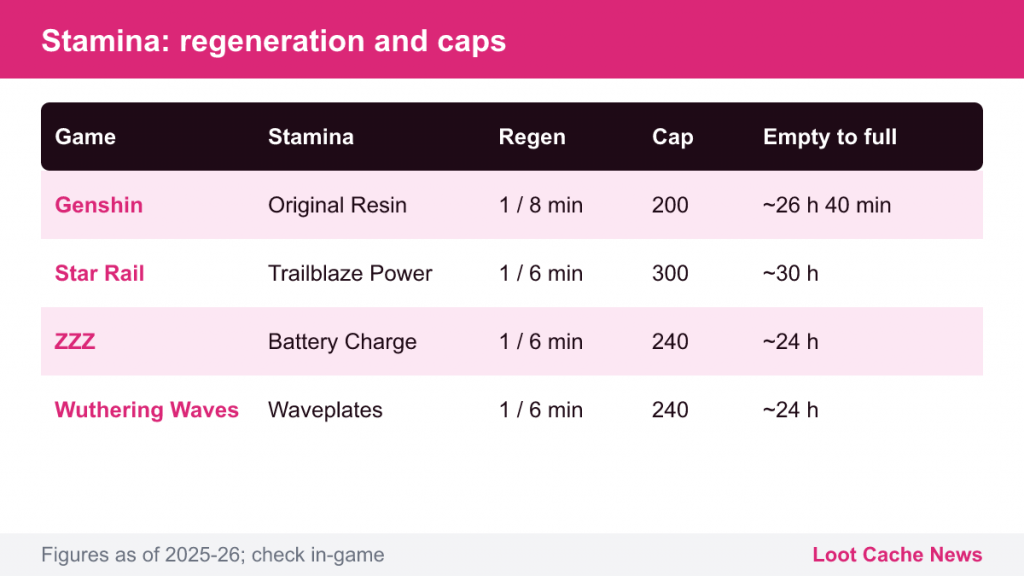
| Game | Stamina | Regeneration | Cap (as of 2025–26) | Time from empty to full |
|---|---|---|---|---|
| Genshin Impact | Original Resin | 1 every 8 minutes | 200 | About 26 hours 40 minutes |
| Honkai: Star Rail | Trailblaze Power | 1 every 6 minutes | 300 | About 30 hours |
| Zenless Zone Zero | Battery Charge | 1 every 6 minutes | 240 | About 24 hours |
| Wuthering Waves | Waveplates | 1 every 6 minutes | 240 | About 24 hours |
These caps have changed over time. Genshin raised its Original Resin cap from 160 to 200 in Version 4.7 (June 2024). Star Rail raised its Trailblaze Power cap from 180 to 240 in Version 1.3 (2023) and again to 300 in Version 3.0 (January 2025). Developers have tended to raise caps rather than lower them, mostly so that players who check in once a day do not lose regeneration overnight. Always check the in-game tooltip for current figures.
Why the cap matters more than the rate
Because each meter takes roughly a day or longer to fill from empty, a player who logs in once every 24 hours and spends their stamina loses little or nothing. The higher caps were designed for exactly that pattern. If you play less often than daily, the overflow features below become important.
Overflow and storage: Condensed Resin, Reserved Trailblaze Power and more
Each game has some way to keep stamina from going completely to waste, though they work differently:
- Genshin Impact: Condensed Resin. You can craft Original Resin into Condensed Resin, a storable item that lets you claim multiple rewards from certain domains and ley lines in one go. The inventory holds only a small number at a time, and the crafting recipe has been adjusted over the years, so check the in-game crafting bench. Genshin has no automatic overflow; if Original Resin sits at its cap, the regeneration is lost.
- Honkai: Star Rail: Reserved Trailblaze Power. Introduced in Version 1.3, this fills automatically when your main meter is at its cap, at a slower rate (one point every 18 minutes), up to 2,400. You can withdraw it later. Star Rail also has Fuel, an item that restores Trailblaze Power and is sometimes given as a reward.
- Zenless Zone Zero: Backup Battery. Once Battery Charge is full, a backup reserve fills slowly and can be converted into regular charge later. Ether Batteries, an item received from rewards, restore 60 Battery Charge each.
- Wuthering Waves: Waveplate Crystals. When Waveplates are capped, the game slowly accumulates Waveplate Crystals as a reserve instead. Crystal Solvent, an item received from rewards, restores 60 Waveplates.
These features make the systems far more forgiving than they once were. A player who skips a few days can usually recover much of what they would have earned. They do not remove the daily rhythm, though: the reserve fills more slowly than the main meter.
What costs stamina and what doesn’t
Knowing exactly where stamina goes is the key to using it well. In all four games the pattern is similar.
| Game | Typical stamina activities | Free activities |
|---|---|---|
| Genshin Impact | Domains (talent books, weapon materials, artifacts), Ley Line Outcrops (Mora and EXP books), normal and weekly bosses | Story and world quests, exploration, chests, daily commissions, most events |
| Honkai: Star Rail | Calyx (Golden and Crimson), Stagnant Shadows, Caverns of Corrosion, Echoes of War weekly bosses, some Ornament and Universe rewards | Story, exploration, daily training, Simulated Universe runs themselves, most events |
| Zenless Zone Zero | Routine Cleanup, Expert Challenges, Notorious Hunt bosses, Drive Disc farming | Story, commissions, Hollow exploration events, daily errands, most events |
| Wuthering Waves | Simulation Challenges, Forgery Challenges, Boss Challenges, Weekly Challenges, Tacet Fields | Story, exploration, overworld Echo hunting, most events |
Note the pattern: stamina is spent on claiming rewards, not on playing. In most of these activities you can enter and fight without spending anything; stamina is only consumed when you collect the drops. Weekly bosses in each game often have a separate, discounted claim limit, which is why they are usually considered the best use of stamina when available.
The refill-purchase pitfall
All four games let you refill stamina with premium currency, the same Primogems, Stellar Jade, Polychromes and Astrite that otherwise become pulls. There is usually a limit on how many times per day you can do this, and the cost goes up with each refill.
For most players, this is a poor trade, for three reasons:
- The currency has another use. Every refill spends premium currency that would otherwise count toward pulls. Our guide to gacha currencies shows how 160 of it equals one pull in all four games, so even one refill is a meaningful fraction of a pull.
- The rewards are random. Equipment domains in particular drop pieces with random stats. A refill buys more rolls, not better ones, and chasing perfect equipment can absorb any amount of stamina.
- The time you save is small. Stamina regenerates fully in about a day. A refill moves you forward by hours, while new content is paced in weeks.
Rising refill costs are a classic example of a design that rewards impatience. If you ever feel the pull to refill, it is worth asking whether the material is needed today, or whether tomorrow’s free regeneration would do the same job. For a broader approach to keeping gacha spending in check, including a limit of zero, see our guide to setting a spending limit.
Using stamina well without overthinking it
Stamina efficiency has generated endless community spreadsheets, but the basics are simple:
- Spend before you hit the cap. Regeneration stops when the meter is full (apart from the overflow features above). Logging in once a day is enough to avoid most waste.
- Prioritise character progression early. In the early game, levelling characters, weapons and talents usually matters more than chasing perfect equipment.
- Use weekly bosses first. Weekly claims often provide rare materials you cannot get elsewhere.
- Plan for the characters you have. Farming materials for a character you do not own yet is a common way banner hype pulls players into spending decisions.
- Accept “good enough” equipment. Equipment upgrades have diminishing returns. Story content and most events do not require optimised gear.
Each game’s beginner guide covers where early stamina is best spent: see our Genshin Impact beginner’s guide for one example, and the matching guides for the other games for specifics.
Why stamina makes short sessions enough
It is easy to see stamina as a restriction, but it has an upside for anyone who wants games to fit around the rest of their life. Because the most rewarding farming is capped per day, there is little benefit to marathon sessions. A daily routine of spending stamina and finishing daily tasks can take a short time once you are familiar with a game, and the rest of your playtime can go to story, exploration or events at whatever pace you like.
That also makes it easier to step away. With overflow storage and higher caps, missing a day or two costs little. If a game starts to feel like a chore because of daily stamina, that is a perfectly good signal to play less often, or to pick one game rather than running several sets of meters at once.
Common mistakes with stamina
- Letting the meter sit full. In Genshin especially, any regeneration past the cap is simply lost.
- Using condensed or stored stamina too early. Storage items are most useful on days you cannot play, or when new content makes a particular domain urgent.
- Farming equipment before characters are levelled. Levels and talents usually offer more for the stamina spent.
- Refilling with premium currency out of habit. It quietly drains the currency you might want for something else.
- Feeling obligated to maximise every day. Stamina rewards consistency, not perfection.
Quick answers
Does stamina regenerate while I am offline?
Yes. In all four games, stamina regenerates in real time whether or not the game is running.
Can I play without spending stamina?
Yes. Story, exploration, most events and many challenge modes do not cost stamina. Only certain reward claims do.
Is it worth playing several gacha games at once?
That depends on your time. Each game has its own daily meter, and running several can turn into a routine of chores. Many players find it more enjoyable to focus on one.