Honkai: Star Rail Combat Explained: Toughness, Weakness Break and Skill Points
How Honkai: Star Rail's turn-based combat works: Speed and action order, the shared Skill Point pool, Energy and Ultimates, Toughness and Weakness Break.
Honkai: Star Rail looks like a classic turn-based RPG at first glance: four party members, a row of enemies, and a menu of attacks. Underneath, it has a handful of interlocking systems that decide who acts when, how much damage gets through and how quickly a fight ends. Understanding them turns combat from “press the biggest button” into a series of small, satisfying decisions.
This explainer covers the core pieces in the order you will notice them: Speed and the action order, the shared Skill Point pool, Energy and Ultimates, Toughness and Weakness Break, the break effects of each element, and the overworld Techniques that shape how a fight begins. For setting, platforms and early-game priorities, start with our Honkai: Star Rail beginner’s guide.
Speed and the action order
Turn order in Star Rail is not a simple “your side, then their side”. Every character and enemy has a Speed stat, and the timeline along the left side of the screen shows who acts next. Faster units act more often.
Behind the timeline is a value players call Action Value. The commonly cited formula is 10,000 divided by Speed: a unit with 100 Speed needs 100 Action Value to reach its turn, while one with 160 Speed needs only 62.5. Each time a unit acts, its countdown resets. This is why small increases in Speed can add extra turns over a long fight, and why community guides talk about “Speed breakpoints”.
Several effects manipulate the timeline directly:
- Action Advance moves an ally forward on the timeline, letting them act sooner.
- Action Delay pushes an enemy back, buying your team time.
- Speed buffs and debuffs change how quickly the countdown runs for the rest of the fight or for a few turns.
Ultimates are the exception to the timeline: they can be used at almost any moment, as described below.
The Skill Point economy
Each character has three main actions on their turn: a Basic Attack, a Skill, and (when charged) an Ultimate. Skills are usually much stronger than Basic Attacks, but they cost a resource shared by the whole team: Skill Points.
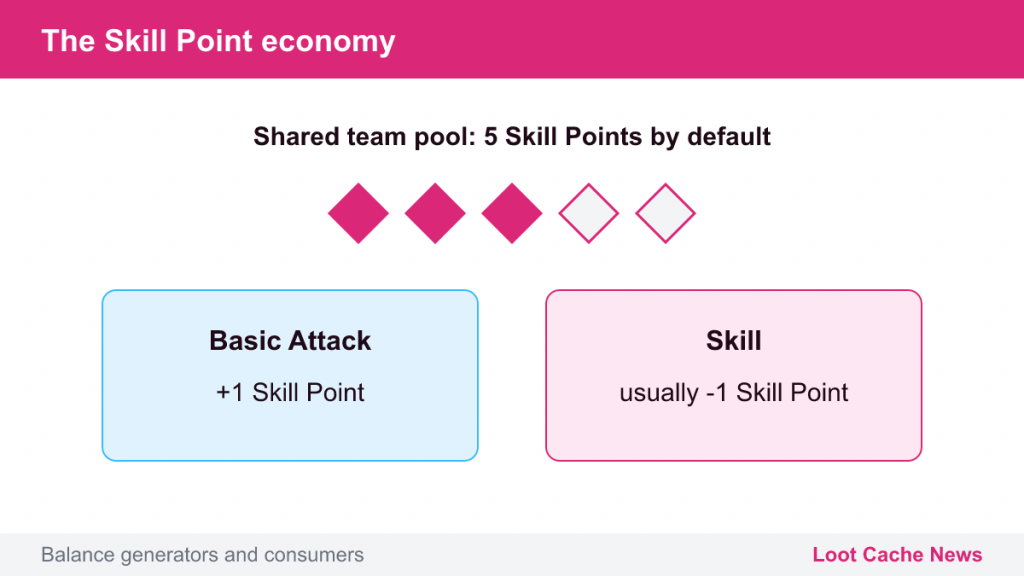
- The team shares one pool of Skill Points, shown as small diamonds near the bottom right of the screen. By default the pool holds five.
- Using a Basic Attack generates one Skill Point.
- Using a Skill normally costs one Skill Point.
- Some characters have abilities that generate extra points, cost more than one, or change the cap.
This shared pool is the central tension of Star Rail combat. If every character uses their Skill every turn, the pool empties almost immediately. A typical team mixes characters who “consume” Skill Points with ones who are happy to Basic Attack and “generate” them. Players often describe characters as Skill Point positive, neutral or negative, and a balanced team usually has at least one generator.
A practical rule of thumb for new players: if a support character’s Skill is a buff that lasts several turns, you rarely need to recast it every turn. Using a Basic Attack in between keeps the pool healthy for your main damage dealer.
Energy and Ultimates
Ultimates are each character’s most powerful ability. They are fuelled by Energy, which builds up as characters act. Using a Basic Attack or Skill grants Energy, being hit by enemies grants Energy, and defeating enemies grants some too. When the circular icon on a character’s portrait fills up, the Ultimate is ready.
The key feature of Ultimates is timing: they can be used outside the normal turn order. As soon as a character’s Energy is full, you can tap their portrait and the Ultimate fires immediately, even during another unit’s turn window. Some Ultimates are best used straight away; others are worth holding until a buff is active, an enemy has been broken, or a new wave arrives. The Energy Regeneration Rate stat increases how quickly Energy builds up, which is why it matters so much for support characters whose Ultimates provide team-wide buffs.
Toughness and Weakness Break
Most enemies have two bars: their health and a white Toughness bar below it. Above the Toughness bar, small icons show the enemy’s elemental weaknesses. Only attacks of a matching element reduce Toughness.
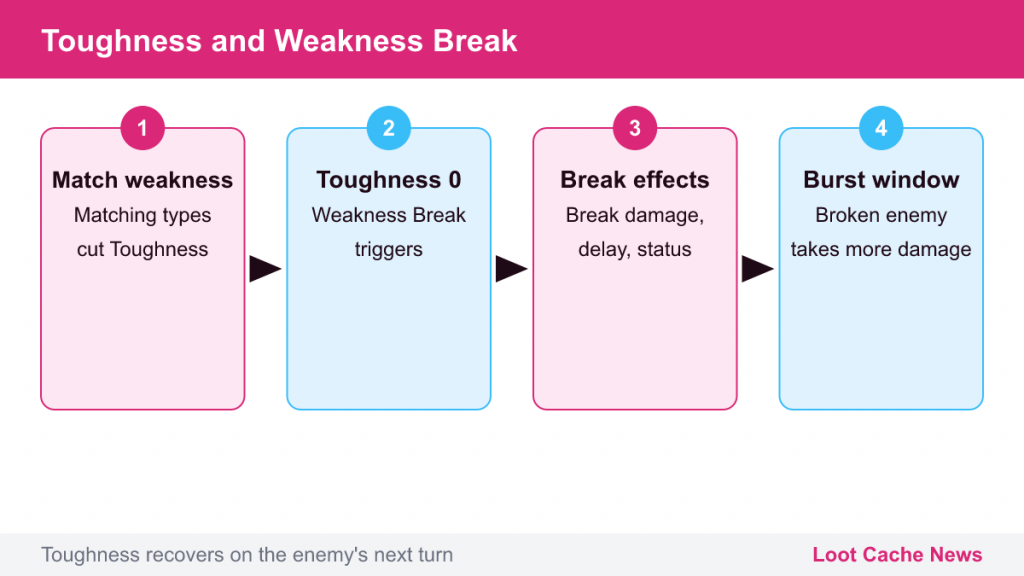
When an enemy’s Toughness hits zero, it suffers a Weakness Break. Three things happen:
- The attack deals extra Break damage of the attacking element.
- The enemy’s next action is delayed.
- An element-specific status effect is applied (see the next section).
A broken enemy also takes more damage from all sources while it is in the broken state, until its next turn arrives and its Toughness recovers to full. This creates a natural rhythm to fights: chip away at Toughness with weakness-matching attacks, break the enemy, then unload your strongest damage while it is vulnerable.
Break damage itself has its own rules. It grows with a stat called Break Effect, with the character’s level and with the enemy’s maximum Toughness, and it cannot critically hit. Some later mechanics, including a type of damage called Super Break, build on this further, letting dedicated break teams deal much of their damage through Toughness reduction itself.
Why weaknesses matter even if you don’t build for break
Even a team that does not specialise in Break benefits from matching weaknesses. Breaking an enemy delays its turn and stops dangerous attacks, and some bosses lose powerful charged moves when broken mid-charge. Bringing at least one or two characters whose elements match a stage’s enemies is one of the simplest ways to make a difficult fight easier, and the game shows enemy weaknesses before you start most challenges.
Weakness Break effects by element
Star Rail has seven combat elements, and each produces a different status effect when it breaks an enemy:
| Element | Break effect | What it does |
|---|---|---|
| Physical | Bleed | Physical damage over time, based partly on the enemy’s maximum HP (with limits on bosses) |
| Fire | Burn | Fire damage over time |
| Ice | Freeze | The enemy is frozen and cannot act, then takes extra Ice damage when it thaws |
| Lightning | Shock | Lightning damage over time |
| Wind | Wind Shear | Wind damage over time that can stack, with more stacks applied to elite and boss enemies |
| Quantum | Entanglement | Delays the enemy’s action and deals extra Quantum damage when its turn arrives; the damage grows if the enemy is hit while entangled |
| Imaginary | Imprisonment | Delays the enemy’s action and lowers its Speed |
The damage-over-time effects (Bleed, Burn, Shock and Wind Shear) are why some characters specialise in “DoT” teams that trigger these effects repeatedly. Freeze, Entanglement and Imprisonment are more about controlling the timeline, giving your team extra breathing room.
Techniques and how fights begin
Combat in Star Rail starts in the overworld. Every character has a Technique: an ability used outside battle that costs Technique Points, shown as a small bar near the minimap. Points are restored by breaking certain destructible objects scattered around maps, and by resting.
Techniques fall into a few broad types:
- Attack Techniques hit an enemy in the overworld and start combat with an effect, such as damage, a debuff or reduced Toughness.
- Buff Techniques are used before a fight and grant a bonus that carries into the next battle.
- Utility Techniques help with exploration, such as making the party harder to detect.
How you start a fight matters too. If you strike an enemy first in the overworld, your team gets the opening advantage, and hitting with a character whose element matches the enemy’s weakness can deal Toughness damage before the battle screen even appears. If an enemy reaches you first, it may get the opening move instead. Learning to open with the right character is a free, skill-based way to make fights shorter.
Putting it together: the rhythm of a turn
Once these systems click, each turn becomes a short checklist:
- Check the timeline. Who acts next? Is a dangerous enemy about to move?
- Check Toughness. Is an enemy close to breaking? Which of your characters matches its weakness?
- Check Skill Points. Can you afford a Skill, or would a Basic Attack keep your main damage dealer supplied?
- Check Ultimates. Is anyone full on Energy, and is now the right moment to use it?
Auto-battle exists and works fine for easy content and farming, and the game lets you speed up combat animations. For harder fights, though, manual play using this checklist often succeeds where auto-battle struggles, which is a good reminder that clearing content depends on decisions as much as on the characters you own.
Common mistakes new players make
- Spending every Skill Point on supports. Your damage dealer runs dry. Let buffers Basic Attack when their buffs are already active.
- Ignoring weakness icons. Bringing a team with no matching elements makes Break impossible and fights much longer.
- Firing Ultimates at the wrong time. A big area Ultimate used just before a new wave of enemies appears is partly wasted.
- Underrating Speed. A few extra points of Speed can grant an extra turn across a fight, which often matters more than a small damage increase.
- Forgetting Techniques. Starting every fight with a buff or a free hit costs nothing but a few Technique Points.
Quick answers
Do I need specific characters to break enemies?
No. Every character reduces Toughness when their element matches a weakness. The free characters the story provides cover several elements, including the Trailblazer, whose Path and element change as the story progresses.
Does Break damage scale with Attack?
Not directly. Break damage depends mainly on Break Effect, character level and the enemy’s maximum Toughness, and it cannot crit.
Can I fail a fight because of turn order alone?
It is possible in harder endgame content, where enemies act quickly and hit hard. In story content, sensible use of breaks and Skill Points is almost always enough.
Star Rail’s combat rewards attention more than anything else. Read the timeline, respect the Skill Point pool and hit weaknesses whenever you can, and you will find that the characters you already have go much further than you might expect.