Gacha Drop Rates Explained: What a 0.6% Rate Really Means
Base rates, consolidated rates, why pulls have no memory, and expected versus worst-case pull counts, explained with simple probability.

Every major gacha game publishes its drop rates. Open the details page on a Genshin Impact or Honkai: Star Rail character banner and you will find a 5-star base rate of 0.6%. Wuthering Waves lists 0.8% for its featured Resonator banner. These numbers are printed in small type, read by few players, and understood by even fewer. That is a shame, because a little probability goes a long way toward making calm, informed decisions, including the decision not to pull at all.
This guide explains what a published rate actually means, the difference between a base rate and a consolidated rate, why each pull is independent, how expected and worst-case pull counts differ, and why the pull videos you see online give a distorted picture. No advanced math is needed.
Reading the Rates Page
A typical banner details page lists several numbers. Taking a HoYoverse limited character banner as the example, as published through 2025 and 2026:
- Base rate for a 5-star: 0.6% per pull.
- Consolidated rate for a 5-star: 1.6%, which is the overall rate once the guarantee is taken into account.
- Guarantee: at least one 5-star within 90 pulls.
- Featured split: when you get a 5-star, it has a 50% chance of being the featured character; if not, the next one is guaranteed to be featured. In Genshin Impact, the Capturing Radiance mechanism added in version 5.0 raises the published consolidated chance that a 5-star from the character banner is the featured one to 55%.
- 4-star rates and a guarantee of at least one 4-star or better every 10 pulls.
Other games use the same structure with different numbers. Genshin Impact’s weapon banner lists a 0.7% base rate and a 1.85% consolidated rate with an 80-pull guarantee. Wuthering Waves’ featured Resonator banner lists 0.8% base with an 80-pull guarantee. The details page is the authoritative source for each banner, so it is worth checking even if you think you already know the numbers.
Base Rate vs Consolidated Rate
The base rate is the chance on a single pull before any pity effect kicks in. The consolidated rate is an average over many pulls that includes the effect of the guarantee and any increase in odds near it.
The gap between the two is large. At a flat 0.6%, the average number of pulls between 5-stars would be about 167 (that is, 1 divided by 0.006). With the guarantee and the rate increase players call soft pity, the consolidated rate of 1.6% works out to an average of about 62.5 pulls per 5-star. Most of that difference comes from the late part of the pity counter, where many players report results clustering. Our guide to pity systems explains that part in detail.
A key point: the consolidated rate is an average across all players and all pulls. It does not mean you will get a 5-star every 62 or 63 pulls. Some players get one in the first ten; others go all the way to 90.
Pulls Have No Memory
Outside of the pity counter, each pull is independent of the ones before it. The game does not “owe” you a good result because you have had a dry streak, and getting a 5-star does not make the next one less likely beyond what the published rules say. Believing otherwise is a classic thinking error known as the gambler’s fallacy.
It is easy to fall into. After 40 pulls without a 5-star, it feels as though one must be “due”. But under the base rate, pull 41 has the same 0.6% chance as pull 1. Only the explicit pity mechanics, the rate increase near the cap and the hard guarantee, change the odds, and they are tied to the counter, not to luck, timing or feelings.
Superstitions do not change anything
Communities around gacha games share many rituals: pulling at a specific time, after a certain in-game action, single pulls versus ten-pulls, or in a particular location. None of these affect the outcome. The number of pulls you make and the banner you make them on are the only things you control. Ten single pulls and one ten-pull have the same odds, with the same 4-star guarantee rules, in the games covered on this site.
What 0.6% Looks Like Over Many Pulls
To get a feel for a low rate, it helps to ask a simple question: if the rate were a flat 0.6% with no pity at all, what is the chance of getting at least one 5-star in a given number of pulls? The formula is 1 minus 0.994 raised to the number of pulls.
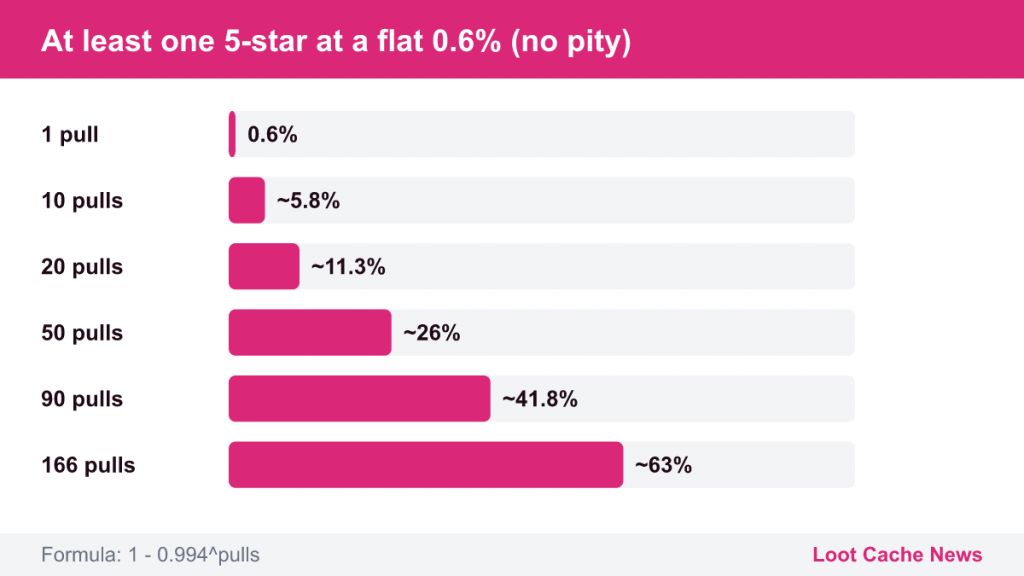
| Pulls | Chance of at least one 5-star at a flat 0.6% |
|---|---|
| 1 | 0.6% |
| 10 | about 5.8% |
| 20 | about 11.3% |
| 50 | about 26% |
| 90 | about 41.8% |
| 166 | about 63% |
This table describes a world without pity. It is not what happens on real banners, where the rate increases late and the guarantee caps the count. But it makes one thing very clear: at the base rate, a ten-pull has only about a 1-in-17 chance of containing a 5-star. If a single ten-pull ever feels like it “should” produce one, the numbers say otherwise. It also shows why pity exists: without it, even 166 pulls would leave more than a third of players empty-handed.
Expected Cost vs Worst-Case Cost
Two numbers matter when you think about a specific character:
Expected (average) pulls
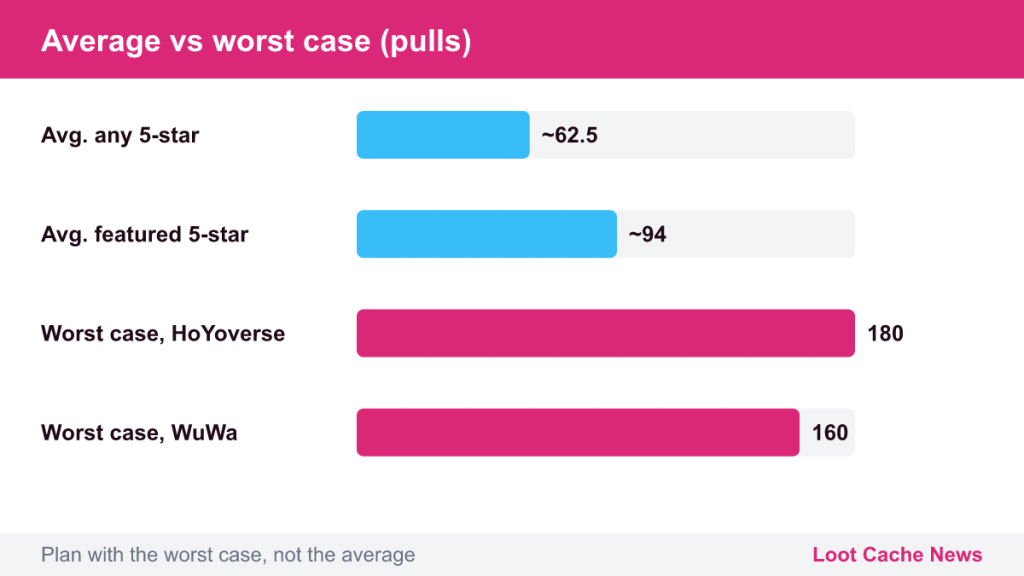
Using the consolidated rate of 1.6%, the average 5-star on a HoYoverse character banner takes about 62.5 pulls. With a 50/50 for the featured character, the average number of 5-stars needed to get the featured one is 1.5 (half the time you need one, half the time two), giving an average of roughly 94 pulls. Capturing Radiance in Genshin Impact nudges that average down a little.
Worst-case pulls
The worst case is fixed by the rules: 90 pulls for a 5-star that turns out not to be the featured character, plus 90 more for the guaranteed one, for a total of 180. In Wuthering Waves, with an 80-pull guarantee on both steps, the worst case is 160.
Averages are useful for understanding, but they are a poor basis for planning. Half of all players will need more than the typical number. If you are deciding whether your saved free currency is enough for a character, the worst case is the number that protects you from coming up short and feeling pushed to top up.
Why Pull Videos Distort Perception
Online, gacha pulls are a popular kind of content: streams and short clips of people opening dozens of pulls, often with big reactions. These videos are entertaining, but they give a misleading impression of how the rates work, for several reasons.
- Selection bias. Lucky results are more likely to be clipped, shared and recommended. A video of 90 pulls producing nothing special is rarely the one that goes viral.
- Volume. Content creators often make far more pulls than a typical player, sometimes many hundreds per banner. Seeing many 5-stars in a video says little about what a small budget produces.
- Compression. A highlight reel shows the moment of a 5-star, not the long stretch of 3-star results before it.
- Emotional framing. The excitement of the reveal is part of what makes the content work. It can make pulling feel more rewarding than the actual odds suggest.
None of this means you should avoid such videos. Just keep in mind that they are a curated, entertainment-first slice of a random process, not a sample of typical outcomes.
Using Rate Disclosures to Set Limits
Rate disclosures exist partly because regulators and platforms required them. China mandates probability disclosure for randomized items, and storefronts and rating bodies have pushed in the same direction; the ESRB, for example, has flagged games with paid random items since 2020. Those disclosures are most useful when you actually use them.
- Before a banner starts, read its details page. Note the base rate, the guarantee number and the featured split.
- Check your current counter. Your pull history tells you how far you are from the guarantee and whether you are already guaranteed the featured character.
- Calculate the worst case. Compare it with the free currency you have saved.
- Decide in advance. If the worst case exceeds what you have, decide before you start whether you will stop at your current total. Zero additional spending is a perfectly reasonable rule.
- Stick to the plan during the pulls. The moment after a near miss is exactly when the gambler’s fallacy feels most convincing.
A Few Myths, Briefly Corrected
- “The rates are lower than published.” Community analyses of large shared pull histories have generally landed close to the published figures, though some players argue about small differences in how the consolidated rate is calculated. The published rules page remains the best reference you have.
- “New accounts have better luck.” Beginner banners have their own published rules; otherwise, rates are the same for everyone.
- “Spending money changes your luck.” Paid and free currency produce identical pulls.
- “Losing the 50/50 three times in a row means the system is rigged.” With a 50% chance each time, three losses in a row happen to roughly one in eight players over three featured 5-stars. With millions of players, many will see such streaks.
Understanding probability will not make your pulls luckier. It will make your decisions better, which is worth more. For the basic structure behind all of this, see our explainer on what a gacha game is.