Pity Systems Explained: Soft Pity, Hard Pity and Guarantees
What pity means in gacha games, how hard pity, soft pity and guarantees work, and why pity is best used as a budgeting ceiling rather than a goal.
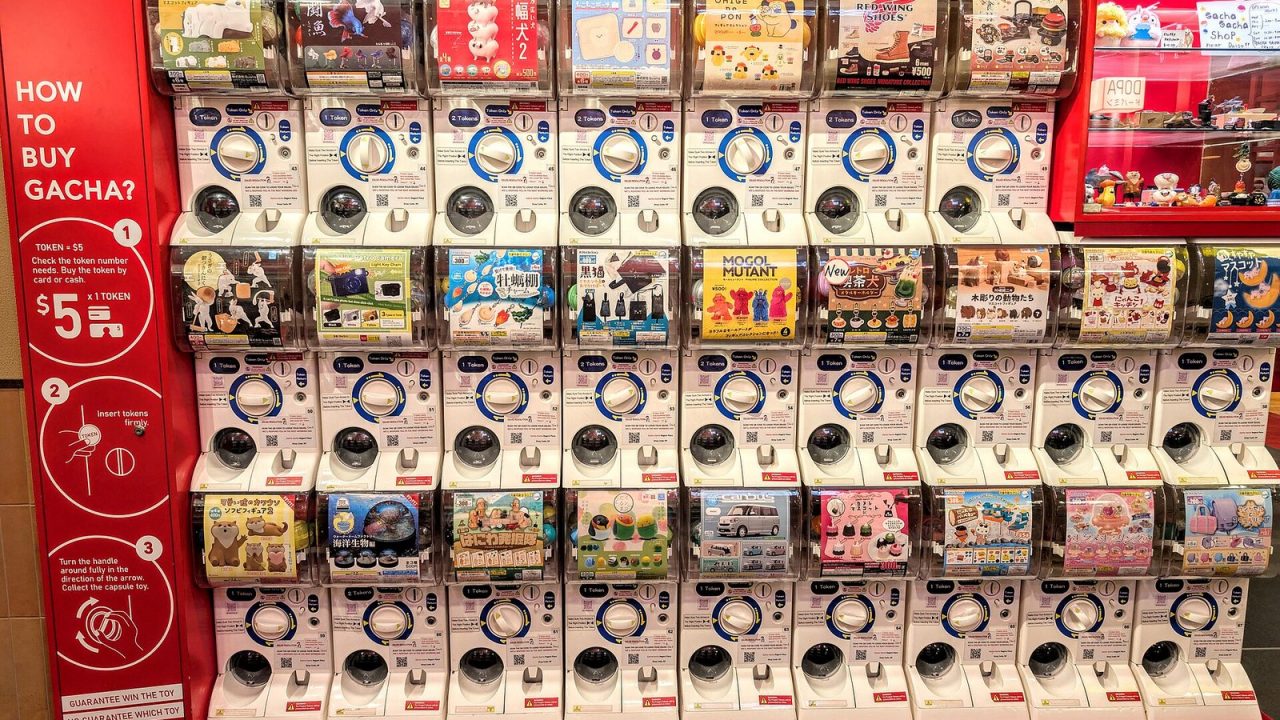
“Pity” is one of the first words a new gacha player learns, and one of the most misunderstood. It gets used for a guaranteed reward, for a rising drop rate, for a counter that carries over between banners, and for the feeling of finally getting a 5-star after a long dry streak. Those are related ideas, but they are not the same thing, and mixing them up leads to bad decisions.
This explainer separates the pieces: what a pity system is, what “hard pity” and “soft pity” actually mean, how guarantees and the 50/50 work, how counters behave between banners, and how the numbers differ across Genshin Impact, Honkai: Star Rail, Zenless Zone Zero and Wuthering Waves. Most of all, it explains why pity is most useful as a worst-case ceiling for planning, never as a target to chase.
What a Pity System Is
In a gacha game, each pull draws a random result from a pool. The highest rarity results, 5-star characters in most games and S-rank agents in Zenless Zone Zero, have a low published base rate, usually somewhere between about 0.6% and 1% per pull. With pure independent randomness, there would be no upper limit on how many pulls a very unlucky player might need.
A pity system puts a limit on that bad luck. The game keeps a counter of how many pulls you have made on a banner since your last top-rarity result. When the counter reaches a fixed number, the next pull is guaranteed to be top rarity, and the counter resets. Most games also run a smaller pity for the middle tier: at least one 4-star (or A-rank) item in every 10 pulls.
A related mechanic, sometimes called “sparking”, awards points with each pull that can be exchanged for a featured item once you have enough. Either way, the effect is the same: an open-ended random process gets a known maximum cost.
Hard Pity: The Fixed Guarantee
Hard pity is the guarantee itself, the pull number at which a top-rarity result is certain. It is published by the game on the banner’s details or rules page, which makes it the most reliable number in the whole system.
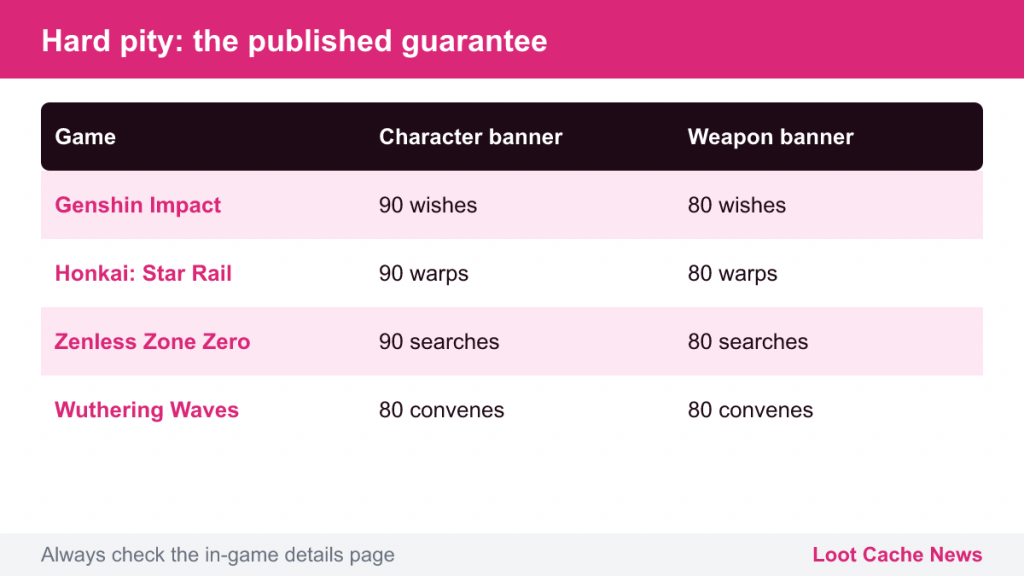
| Game | Character banner hard pity | Weapon / equipment banner hard pity |
|---|---|---|
| Genshin Impact | 90 wishes (5-star) | 80 wishes (5-star weapon) |
| Honkai: Star Rail | 90 warps (5-star) | 80 warps (5-star Light Cone) |
| Zenless Zone Zero | 90 searches (S-rank agent) | 80 searches (S-rank W-Engine) |
| Wuthering Waves | 80 convenes (5-star Resonator) | 80 convenes (5-star weapon) |
These figures come from each game’s in-game rule pages as published through 2025 and 2026. Rules can change with updates, so the in-game details screen is always the final word. Two quick observations from the table: HoYoverse’s three games share almost identical structures, and Wuthering Waves uses a lower 80-pull ceiling on its character banner but a slightly higher base rate (0.8% versus 0.6%).
Soft Pity: A Community Observation, Not a Published Rule
Soft pity refers to a point before hard pity where the chance of a top-rarity result appears to climb sharply. For Genshin Impact character banners, players who have analyzed large sets of shared pull histories commonly describe the increase as starting around the 74th pull, which is why so many 5-stars show up in the mid-to-high 70s rather than at exactly 90. Players report similar curves on the other HoYoverse games, and Wuthering Waves players describe an equivalent increase before its 80-pull cap.
The important caveat is in the wording. The exact soft pity curve is generally not spelled out on the in-game rules page in the same way as the base rate and hard pity. What the games do publish is a “consolidated” probability, a rate that includes the effect of the guarantee, which is noticeably higher than the base rate. Soft pity is the community’s explanation of where that extra probability lives, based on large data samples. It is a reasonable model, but it is an estimate, and the specific pull number where it “starts” is not something to bet a budget on.
A practical way to think about it: soft pity means many players reach a 5-star somewhat before hard pity. It does not change your worst case. If you plan around soft pity and get unlucky, you will still need to go all the way to hard pity.
Guarantees and the 50/50
On most limited character banners, your first top-rarity result is not certain to be the featured character. Instead, there is a split. In Genshin Impact, Honkai: Star Rail, Zenless Zone Zero and Wuthering Waves character banners, it is a 50% chance of the featured 5-star and a 50% chance of a character from the standard pool. Players call this “the 50/50”.
If you lose the 50/50, your next top-rarity result on that banner type is guaranteed to be the featured character. This status is usually called “guaranteed” or “the guarantee”. Weapon and equipment banners often use a different split, commonly 75/25 in favor of the featured item on HoYoverse weapon banners, while Wuthering Waves’ featured weapon banner gives the featured 5-star weapon whenever a 5-star drops.
Genshin Impact added a twist in version 5.0 called Capturing Radiance, a mechanism that can turn a lost 50/50 into the featured character in some cases. Its exact behavior is not fully detailed in plain numbers, so the safe planning assumption is still the classic 50/50 with a guarantee.
Why this doubles the worst case
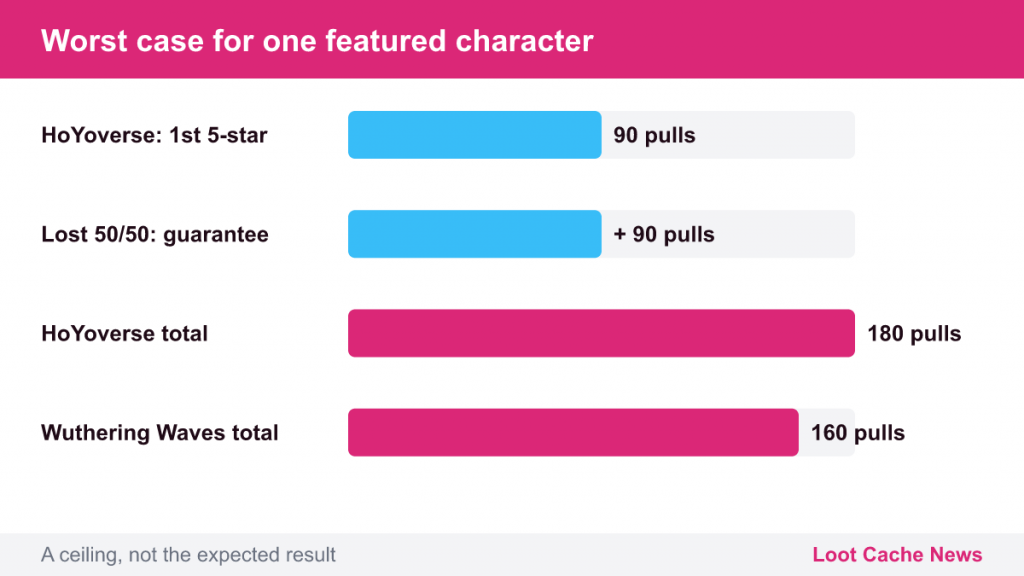
Combine hard pity with a lost 50/50 and you get the true ceiling for one specific limited character:
- Genshin Impact, Honkai: Star Rail and Zenless Zone Zero: up to 90 pulls to the first 5-star, which may be the “wrong” one, then up to another 90 pulls to the guaranteed featured one. That is 180 pulls in the worst case.
- Wuthering Waves: up to 80 plus 80, or 160 pulls.
That number is the one worth knowing before a banner starts. It is the maximum, not the expected result, but it is the figure that protects you from the unpleasant surprise of running out of currency at pull 170.
Pity Carry-Over and Separate Counters
Pity counters do not reset when a banner ends. In the major games, your counter carries over to the next banner of the same type. If you made 60 pulls on one limited character banner without a 5-star, your next limited character banner starts at 60. The same is true for the guarantee status: if you lost a 50/50 and the banner ended before your next 5-star, the guarantee usually carries into the next featured character banner.
What does not carry over is pity between different banner types. Each game keeps separate counters:
- Limited character banners share one counter. When Genshin Impact or Honkai: Star Rail run two featured characters at the same time, both banners use the same counter.
- Weapon or equipment banners have their own counter.
- The standard (permanent) banner has its own counter.
- Special banners, such as beginner banners or Genshin Impact’s Chronicled Wish, have their own rules and counters.
Two practical consequences follow. First, pulls on the standard banner never bring you closer to a limited character. Second, splitting currency between a character banner and a weapon banner means building two separate pity counts, which often leaves both short of a guarantee. Many players avoid weapon banners entirely for exactly this reason, and that is a perfectly reasonable choice.
How Pity Relates to the Rates You See
Every major game shows at least two kinds of numbers on a banner’s details page. The base rate is the chance of a top-rarity result on any given pull before pity effects (0.6% for 5-stars on HoYoverse character banners, 0.8% on Wuthering Waves character banners). The consolidated rate is the overall rate once the guarantee is factored in. On HoYoverse character banners that consolidated figure is published as 1.6%, which works out to an average of roughly one 5-star every 62 or so pulls across a large number of players.
Averages hide a wide spread. Some players hit a 5-star in a handful of pulls, many land in the 70s, and some go to the full 90. That spread is exactly why a single average is a poor planning number and why the worst case matters more. Our separate guide to drop rates goes deeper into what those percentages mean in practice.
Using Pity as a Budgeting Tool
Pity was designed partly as a consumer protection, and it can be used that way. The healthiest way to think about it is as a price ceiling that lets you decide in advance, with full information, whether something is worth your free currency, or whether it is worth anything at all.
- Know your counter before a banner starts. Check your pull history (every game offers an in-game history page) and write down your current pity and whether you are guaranteed.
- Calculate the worst case, not the hopeful case. If you are at 20 pity with no guarantee on a HoYoverse banner, the worst case for the featured character is 70 more pulls to the first 5-star plus 90 more if you lose the 50/50: 160 pulls.
- Compare that number to what you already have. If your saved free currency does not cover the worst case, the honest options are to wait, to pull knowing you may fall short, or to skip. Topping up to “close the gap” is precisely the decision pity pressure is designed to produce.
- Remember that skipping keeps your progress. Because counters carry over, skipping a banner loses nothing. Your pity and any guarantee wait for a character you want more.
Pity is a ceiling, not a goal
Watch out for the sunk-cost trap. Being at 75 pity can feel like you are “almost there”, which creates pressure to keep pulling on whatever banner is running. But nothing is lost by stopping: the counter waits for the next banner of that type. A high pity count is a reason to be patient and choose carefully, not a reason to spend.
Common Mistakes With Pity
- Assuming soft pity is guaranteed. Planning on a 5-star “around 75” leaves you short when it does not arrive until 90.
- Forgetting the 50/50. Counting 90 pulls as the cost of a featured character can be off by a factor of two.
- Pulling on the standard banner for a limited character. Counters are separate; those pulls do not help.
- Mixing banner types. Splitting pulls between character and weapon banners can leave both counters unfinished.
- Trusting memory. Use the in-game history page, not a guess. Third-party trackers exist, but be cautious with any tool that asks you to run scripts or share account access.
Quick FAQ
Does pity reset when a banner ends?
No. In the major games covered here, it carries over to the next banner of the same type, along with any guarantee.
Is the 4-star pity separate from the 5-star pity?
Yes. The “at least one 4-star or better every 10 pulls” rule runs on its own counter. Getting a 5-star in a ten-pull usually satisfies it as well.
Where do I check the official numbers?
On the banner screen, look for a “Details”, “Info” or rules button. It lists base rates, consolidated rates, the pity number and the 50/50 or 75/25 rules. If a guide disagrees with that page, trust the page.