Genshin Impact Elemental Reactions Explained
A clear guide to every Genshin Impact elemental reaction: auras and triggers, Vaporize and Melt, Swirl and Crystallize, Dendro reactions and Lunar reactions.
Elemental reactions are the heart of Genshin Impact’s combat. Almost every fight, puzzle and boss is built around the idea that two elements meeting on the same target produce something stronger, stranger or more useful than either element alone. Once you understand how reactions work, team building stops being a guessing game and the combat starts to feel like a set of tools rather than a button-mashing contest.
This guide walks through the seven elements, the difference between an aura and a trigger, and every major reaction family: amplifying reactions, transformative reactions, the Dendro reactions added with Sumeru, and the Lunar reactions introduced with the Nod-Krai region in 2025. If you are brand new to the game, our Genshin Impact beginner’s guide covers the basics of characters, Adventure Rank and stamina first.
The seven elements and how they interact
Teyvat has seven elements, each tied to one of the seven nations and its Archon: Anemo (wind), Geo (earth), Electro (lightning), Dendro (nature), Hydro (water), Pyro (fire) and Cryo (ice). Every playable character wields one element, and their Elemental Skill and Elemental Burst apply it to enemies. Some normal and charged attacks also apply elements, especially for Catalyst users.
Not every element behaves the same way. Broadly, they fall into three groups:
- Elements that stick to targets: Hydro, Pyro, Cryo, Electro and Dendro can linger on an enemy as an “aura”. These are the elements that most reactions are built from.
- Elements that only react: Anemo and Geo do not leave a lasting aura on enemies. Instead, they react with an element that is already there, through Swirl and Crystallize respectively.
- Special cases: some reactions create their own temporary states, such as Frozen, Quicken or the Dendro Cores produced by Bloom, which can then be reacted with again.
Auras and triggers: the rule that explains everything
Every reaction has two parts. The aura is the element already sitting on the target. The trigger is the element that hits it next. The order matters, sometimes a great deal.
When an enemy is affected by an element, a small icon appears above its health bar. That is the aura. When a different element lands on it, the game checks the pair and produces a reaction. Some auras are consumed by the reaction, some coexist with the new element, and some reactions consume a set amount of the aura and leave the rest in place.
Two practical consequences follow from this:
- Who applies first changes the result. For Vaporize and Melt, the triggering element decides whether the damage bonus is large or small. That is why teams are often described in terms of which character is the “applier” and which is the “trigger”.
- Application strength matters. Different attacks apply different amounts of an element. A strong application can leave enough aura behind for another reaction; a weak one may be fully used up. Players often call this the elemental gauge. You do not need to memorise the numbers to enjoy the game, but it explains why some combinations feel more reliable than others.
Amplifying reactions: Vaporize and Melt
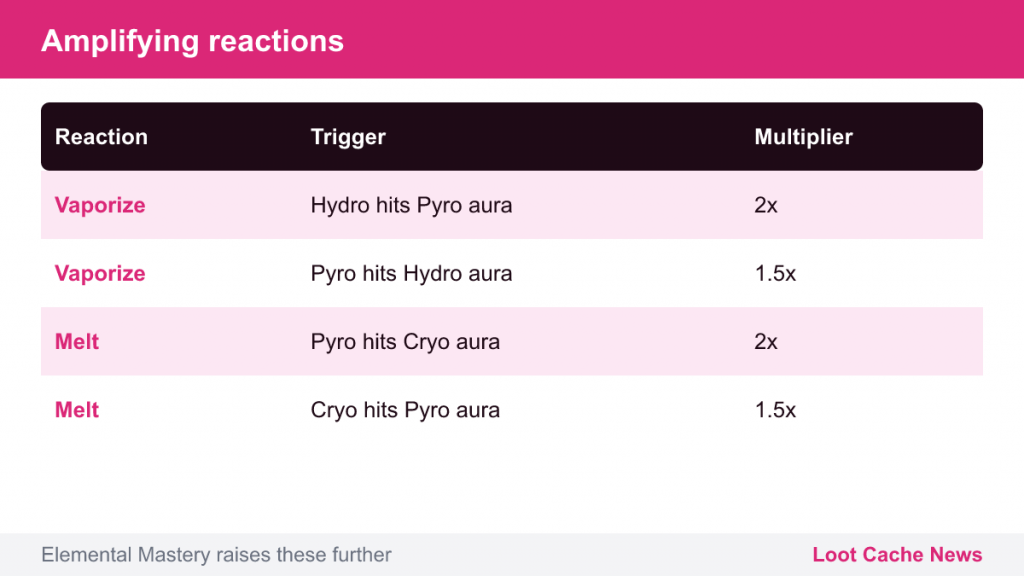
Amplifying reactions do not create a separate damage instance. Instead, they multiply the damage of the hit that triggered them. That makes them the classic choice for teams built around a single strong damage dealer.
| Reaction | Elements | Multiplier |
|---|---|---|
| Vaporize (forward) | Hydro hits a Pyro aura | 2x damage |
| Vaporize (reverse) | Pyro hits a Hydro aura | 1.5x damage |
| Melt (forward) | Pyro hits a Cryo aura | 2x damage |
| Melt (reverse) | Cryo hits a Pyro aura | 1.5x damage |
The base multipliers above are further increased by Elemental Mastery and certain set bonuses. Because the bonus multiplies the triggering hit, players usually try to make their biggest hits the ones that react. A character with a slow, powerful charged attack, for example, benefits more from a well-timed Vaporize than one that attacks rapidly for small amounts.
The “forward” and “reverse” labels are community shorthand, not official terms. The practical takeaway is simple: Hydro is the stronger trigger on Pyro, and Pyro is the stronger trigger on Cryo.
Transformative reactions: Overloaded, Superconduct, Electro-Charged, Swirl and more
Transformative reactions create their own separate damage or effect. Their damage scales with the triggering character’s level and Elemental Mastery rather than with Attack or critical hit stats, which is why support characters can contribute meaningful damage through them even with modest equipment.
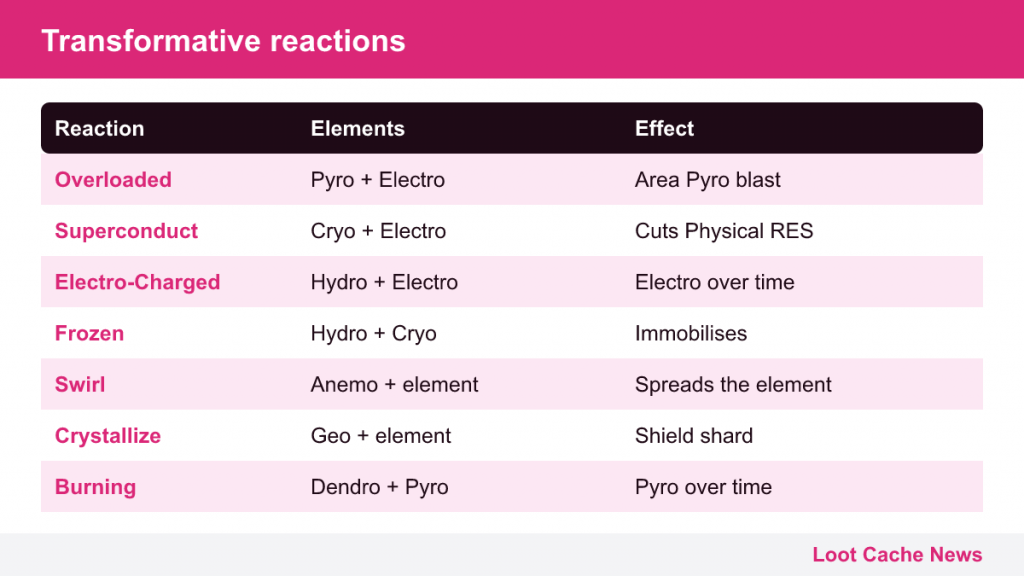
| Reaction | Elements | What it does |
|---|---|---|
| Overloaded | Pyro + Electro | An explosion of Pyro damage in an area, which knocks enemies back |
| Superconduct | Cryo + Electro | Area Cryo damage and a temporary reduction to the target’s Physical resistance |
| Electro-Charged | Hydro + Electro | Electro damage over time; Hydro and Electro coexist on the target and can chain to nearby wet enemies |
| Frozen | Hydro + Cryo | Immobilises the target for a short time |
| Shatter | Heavy (blunt) attacks or Geo on a Frozen target | Breaks the ice for Physical damage and ends the freeze |
| Swirl | Anemo + Pyro, Hydro, Electro or Cryo | Deals damage of the absorbed element and spreads it to nearby enemies |
| Crystallize | Geo + Pyro, Hydro, Electro or Cryo | Drops a crystal shard that grants a shield of the absorbed element when picked up |
| Burning | Dendro + Pyro | Pyro damage over time in an area; can also burn grass in the overworld |
Why Swirl and Crystallize are special
Swirl and Crystallize are the reason Anemo and Geo characters fit into almost any team. Swirl takes an element that is already on an enemy and spreads it to everything nearby, which sets up further reactions across a whole group. Crystallize turns an existing element into a defensive shield, trading damage for survivability. Neither element can be Swirled or Crystallized by itself, and Dendro cannot be Swirled or Crystallized either.
Frozen versus Shatter
Frozen is mainly crowd control. Large bosses are immune to being frozen, but smaller enemies can be locked in place for long stretches by alternating Hydro and Cryo application. Hitting a frozen enemy with a heavy weapon such as a claymore, or with Geo, shatters the ice for extra Physical damage. Teams built around freezing typically avoid heavy weapons for exactly that reason: shattering ends the freeze early.
Dendro reactions: Bloom, Quicken and their follow-ups
Dendro characters arrived in Version 3.0, alongside the Sumeru region, in August 2022. Before that, Dendro existed in the world but no playable character could use it in combat. Its arrival added a whole new family of reactions, several of which chain into each other.
| Reaction | Elements | What it does |
|---|---|---|
| Bloom | Dendro + Hydro | Creates a Dendro Core that explodes after a short delay for area Dendro damage |
| Hyperbloom | Electro hits a Dendro Core | Turns the core into a homing projectile that seeks an enemy |
| Burgeon | Pyro hits a Dendro Core | Makes the core explode immediately in a larger area |
| Quicken | Dendro + Electro | Applies a Quicken aura to the target |
| Aggravate | Electro hits a Quickened target | Adds a flat bonus to that Electro hit’s damage |
| Spread | Dendro hits a Quickened target | Adds a flat bonus to that Dendro hit’s damage |
Two details are worth highlighting. First, Dendro Core explosions from Bloom, Hyperbloom and Burgeon can damage your own active character if they go off near you, so positioning matters. Second, Aggravate and Spread are sometimes called “additive” reactions because they add a flat damage bonus to the triggering hit rather than multiplying it. They sit between amplifying and transformative reactions in how they scale, and they allow critical hits.
Lunar reactions in Nod-Krai
The Nod-Krai region, released with Version Luna I on September 10, 2025, introduced a new layer called Lunar reactions. These are enhanced versions of existing reactions that only occur when a specific type of Nod-Krai character, sometimes called a Moonsign character, is in the party. Once one is present, any team member’s reactions of the right type are converted.
- Lunar-Charged replaces Electro-Charged when an enabling character is in the team. Instead of relying purely on Elemental Mastery, it can benefit from critical hits and combines contributions from the characters applying Hydro and Electro.
- Lunar-Bloom replaces Bloom when its enabling character is in the team. Rather than creating explosive Dendro Cores, it generates a shared resource that powers Lunar-Bloom damage, and it does not hurt your own character the way regular cores can.
- Lunar-Crystallize was added in Version Luna IV in January 2026 and is tied to Geo and Hydro under specific team conditions.
Lunar reactions also interact with a team-wide Moonsign level that rises when more than one enabling character is present, and several new equipment sets reward triggering them. The details are character-specific and have been adjusted as new Nod-Krai characters arrived, so treat the official in-game reaction descriptions as the authoritative reference. The important point for most players is that Lunar reactions do not remove the older ones: without an enabling character, Electro-Charged, Bloom and Crystallize behave as they always have.
How reactions shape team building
Most team archetypes are named after the reaction they lean on. A few examples of how players describe them:
- Vaporize or Melt teams focus on one strong damage dealer with a support that applies the other element frequently.
- Freeze teams pair Hydro and Cryo characters to keep enemies locked in place, often with an Anemo character to group enemies.
- Hyperbloom teams build Elemental Mastery on an Electro trigger while Dendro and Hydro characters produce cores.
- Quicken teams rely on Dendro and Electro to repeatedly trigger Aggravate or Spread.
- Lunar teams are built around Nod-Krai characters that convert reactions into their Lunar versions.
Elemental Resonance adds a separate layer: having two characters of the same element in a four-character party grants a passive team bonus. It is not a reaction, but it often influences whether a team doubles up on an element or spreads across four.
None of this requires any particular character. Every reaction can be triggered with the free characters the story gives you, including the Traveler, who can switch between several elements at Statues of The Seven. Learning reactions with the characters you already have is far more valuable than chasing a specific unit for a specific team.
Common mistakes with elemental reactions
- Triggering the weak version of an amplifying reaction. Letting a Cryo character hit a Pyro aura gives the 1.5x Melt rather than the 2x version. Swapping the order of skills can make a big difference.
- Overloading enemies away from your attacks. Overloaded knocks enemies back, which can scatter groups and waste area damage.
- Shattering your own freeze. Claymore users and Geo characters end Frozen early, which defeats the purpose of a freeze team.
- Standing on Dendro Cores. Regular Bloom explosions can damage your active character.
- Expecting reactions on immune enemies. Some enemies and shields resist certain elements or are only affected in specific ways. Elemental shields, for instance, are best broken with the element that reacts strongly against them.
Quick answers
Do I need Elemental Mastery on every character?
No. Elemental Mastery boosts reaction damage, which matters most for characters who trigger transformative reactions or the big amplifying hits. Many characters prefer other stats.
Is the reaction list final?
No. Dendro reactions were added in 2022 and Lunar reactions in 2025 and 2026. Future regions may add more, so check the in-game tutorial and patch notes when a new version launches.
Reactions reward curiosity. Swap characters, experiment on weak enemies and watch the reaction names that pop up; within a few sessions the pairs become second nature.